Supercontinuum generation
Supercontinuum generation turns a narrowband pulse into a broadband white-light spectrum by driving nonlinear processes in an optical fiber or waveguide. A supercontinuum source spans 400 nm to 2400 nm at several watts of output power, and because the light stays in a single spatial mode it focuses to the diffraction limit of a Gaussian beam. Turn-key fiber versions are sold as white-light lasers and are used in biomedical imaging, spectroscopy and optical device characterization.
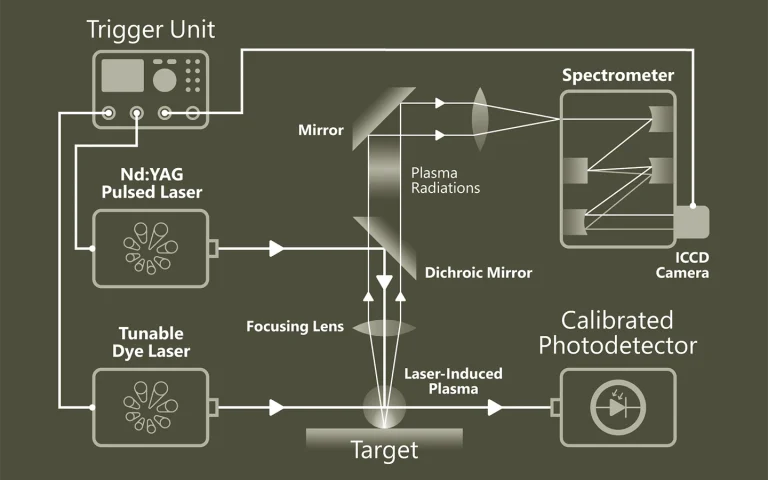
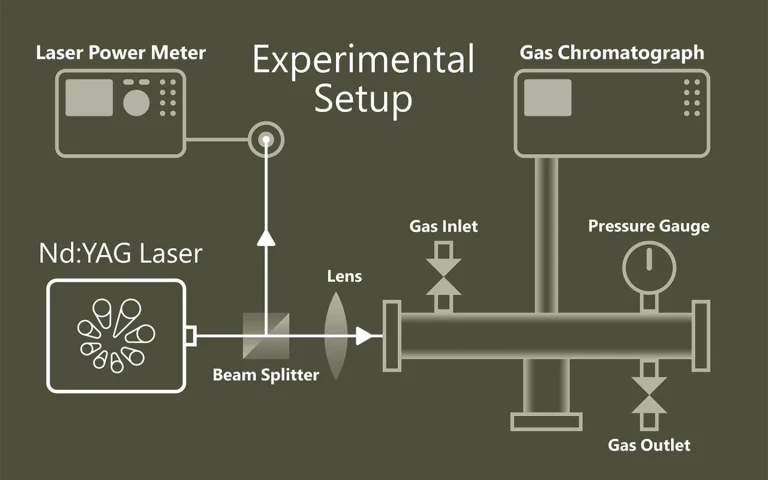
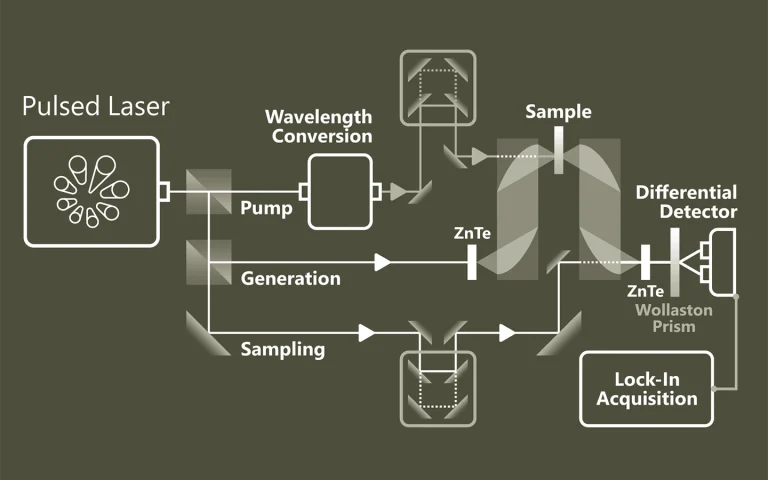
A supercontinuum source needs a pump laser, a coupling stage and a nonlinear medium. Fiber-based systems seed a fiber amplifier from a mode-locked oscillator, then launch its picosecond pulses at about 1064 nm and tens of megahertz repetition rate into a few meters of index-guiding photonic crystal fiber with a tailored dispersion profile. Laboratory setups pump the same fiber from a bulk laser through free-space optics, as the figure shows. A tunable spectral filter then carves the continuum into a widely tunable source.
Ekspla sources drove both experiments listed below. Picosecond pulses at 2.02 µm from a PGx01 optical parametric generator, pumped by a PL2210 picosecond Nd:YAG laser, produced a mid-infrared supercontinuum in step-index fluoroindate fiber with a 5-dB bandwidth covering the entire 2 – 5 µm interval and a cut-off at 5.25 µm. A LightWire FFS fiber seeder drove on-chip generation in Si3N4 waveguides, where the continuum spanned 470 nm to 2130 nm, more than 495 THz of bandwidth.

Principle of supercontinuum generation.