Z-scan
In nonlinear optics, the Z-scan technique measures the nonlinear refractive index n2 (the Kerr nonlinearity) and the nonlinear absorption coefficient Δα. Closed- and open-aperture scans separate the real and imaginary parts of the nonlinear response.
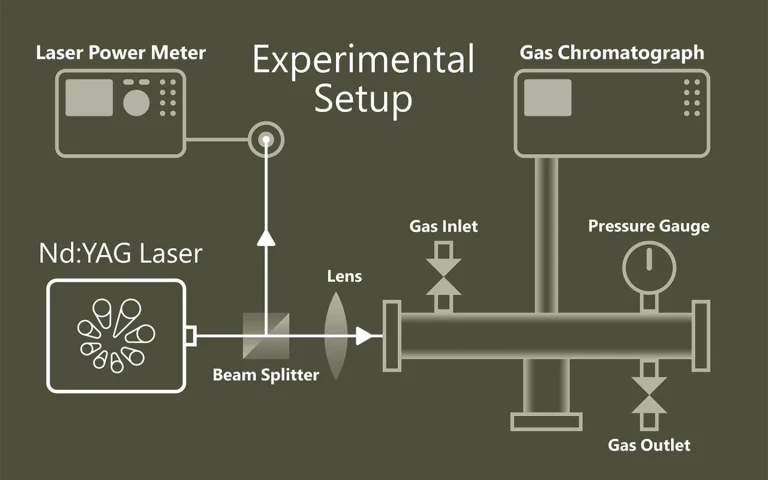
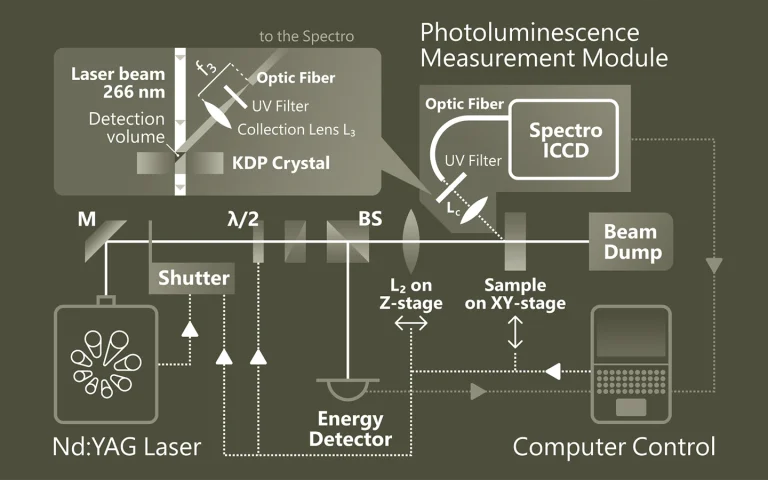
Closed-aperture Z-scan gives the real part. The sample is translated along the beam axis through the focus of the lens, over a range of several Rayleigh lengths, while an aperture in the far field passes only the central part of the beam to the detector. The sample acts as a weak, position-dependent lens, so its focusing power changes how much light reaches the detector, and fitting the transmission against position yields the nonlinear refractive index. A beamsplitter sends part of the input to a reference detector, which normalizes out pulse-to-pulse intensity fluctuations.
Open-aperture Z-scan gives the imaginary part, the nonlinear absorption coefficient. The far-field aperture is removed so the detector collects the whole beam, which makes small beam distortions irrelevant: the remaining variation with position comes entirely from nonlinear absorption.
Two-photon absorption is the main nonlinear absorption channel, and it needs high peak intensity at the focus. Picosecond Nd:YAG lasers supply it: the PL2210 at 1 kHz with up to 2.5 mJ per pulse, and the PL2250 with up to 160 mJ where more energy is needed. Adding a PGx01 optical parametric generator tunes the excitation from 193 nm to 2300 nm, so the nonlinear response can be mapped across the spectrum.
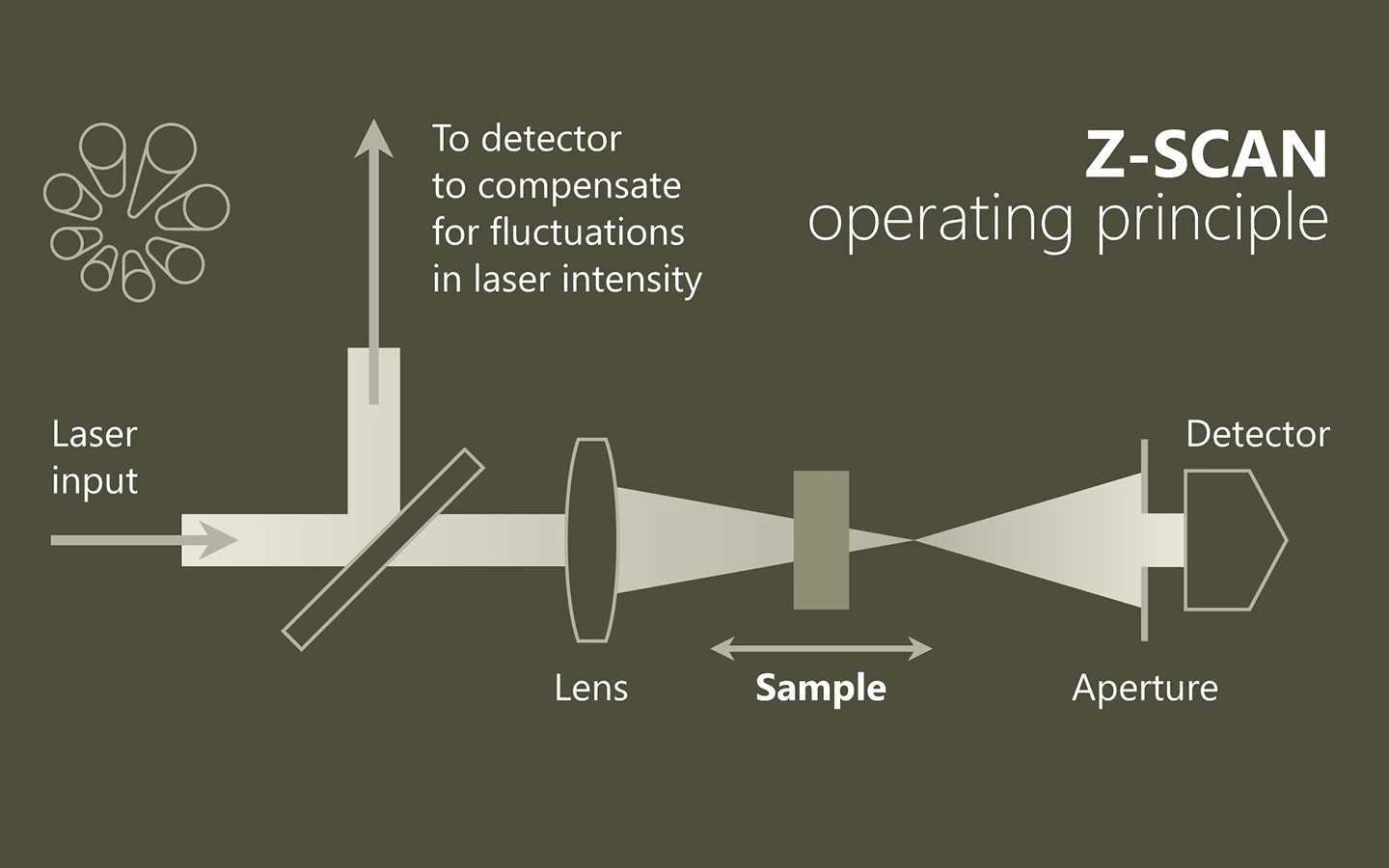
Z-scan operating principle.