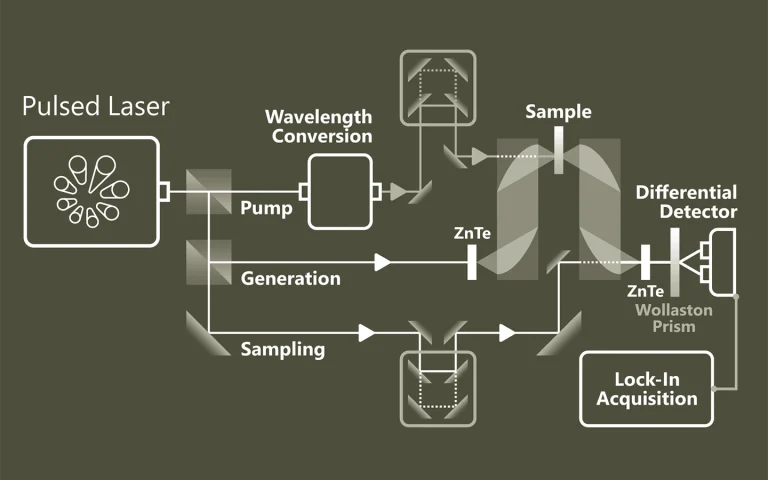
Time-resolved photoconductivity
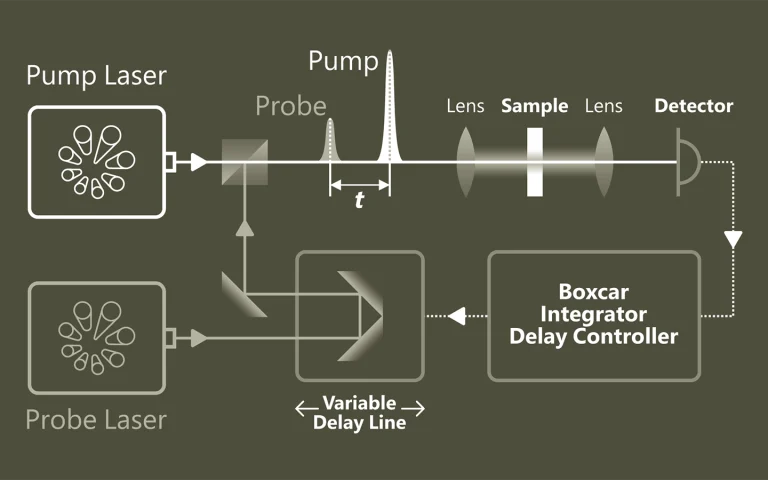
Time-resolved photoconductivity tracks how the conductivity of a material rises and decays after a light pulse, which gives carrier density, mobility, trapping and recombination parameters. The photocurrent can be read through electrodes, as in the photoconductive-switch setup shown here, or without contacts at microwave frequencies, a variant known as time-resolved microwave conductivity (TRMC). Both are applied to organic semiconductors and dyes, inorganic semiconductors and metal-insulator composites.
Photoconductivity responds to photon energy, light intensity and temperature, and its time evolution and frequency dependence separate carrier generation from transport and recombination. Because those processes are well described theoretically, the measurement works as a diagnostic for new electronic materials and devices: conductive inks, thin-film transistors, light-emitting diodes, photocatalysts and photovoltaics.
Wavelength is the control variable, since scanning the excitation across a material’s absorption edge separates band-to-band generation from sub-bandgap and defect states. The work listed below used Ekspla tunable-wavelength OPO lasers for that excitation: the NT240 at 1 kHz for organic solar cells and interfaces, the NT340 with up to 150 mJ in the visible for perovskite films, thin-film transistors and photodetectors.

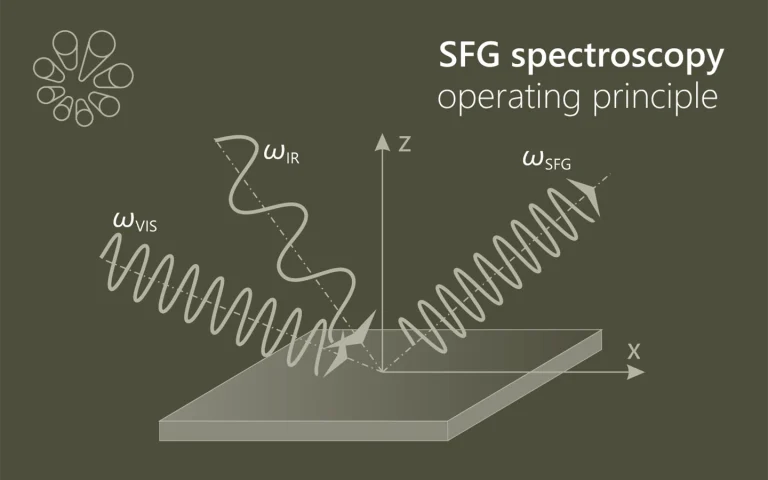
Principle of time-resolved photoconductivity.