LIBS
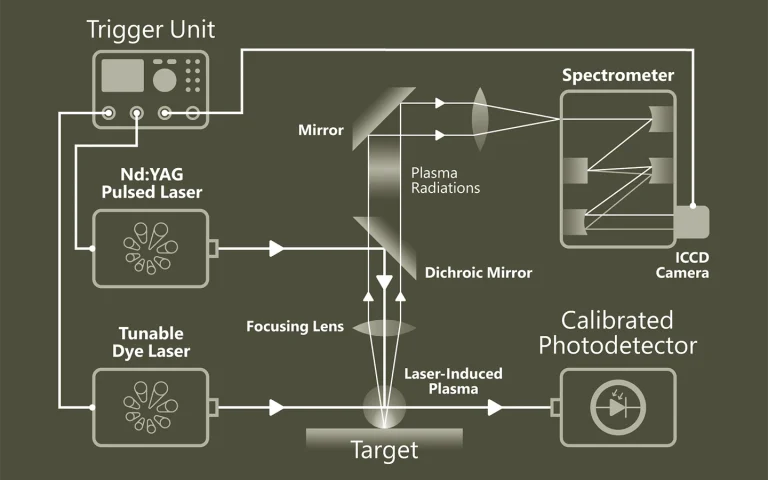
Laser-induced breakdown spectroscopy (LIBS) focuses a high-intensity short laser pulse onto a target, turning a microscopic amount of material into plasma, then reads the light that plasma emits. Every element radiates at its own wavelengths, so a spectrograph and detector covering the right range identify what the sample contains. LIBS works on solids, liquids and gases and needs no contact with the sample, so it reaches targets that require remote analysis or micro-sampling.
Adding scanning optics and translation stages turns the point measurement into a map. Scanning the surface gives an elemental map in two dimensions, and repeating the measurement as successive layers are ablated extends it through the depth, into a three-dimensional composition map.
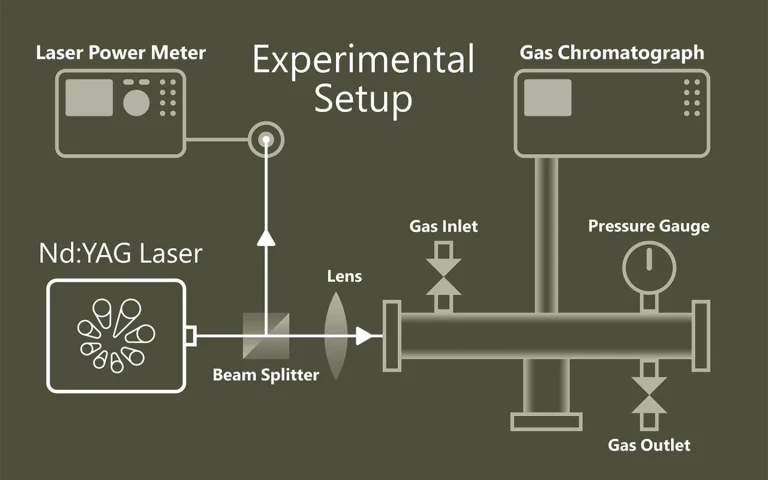
Pulse duration and energy set what LIBS can resolve. Nanosecond Q-switched Nd:YAG lasers are the workhorse: the NL230 delivers up to 190 mJ at 100 Hz, the NL300 up to 1100 mJ, and the NanoFlux SLM reaches 10 J in a single longitudinal mode. Picosecond lasers give a different plasma regime, and one study listed below compared nanosecond with picosecond excitation and improved the gas-phase detection limit for mercury by controlling ambient pressure together with pulse width.

LIBS operating principle.