Plasma physics
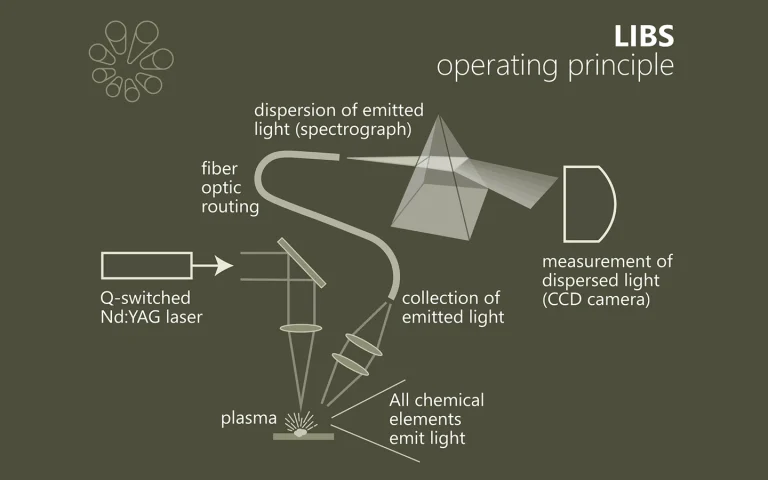
Laser-induced plasma serves a range of diagnostic and technological applications, such as elemental detection, thin-film deposition and material identification. Laser-induced plasma spectroscopy (LIPS), also called laser-induced breakdown spectroscopy (LIBS) or laser spark spectroscopy (LSS), is a powerful tool for rapid in-situ analysis of solid, liquid or gaseous samples. Applications include on-line monitoring in the steel industry, materials and leakage control in power plants, environmental analysis of soils and waters, examination of cultural heritage objects, explosives detection and planetary surface characterization.
Pulsed laser deposition (PLD) is a physical vapor deposition technique in which a high-power pulsed laser beam is focused inside a vacuum chamber to strike a target of the material to be deposited. Conceptually and experimentally, it is one of the simplest thin-film growth techniques.
With progress in short-pulse laser techniques, new plasma applications continue to emerge. Extreme ultraviolet (EUV) sources based on laser-produced plasmas (LPP), emitting at wavelengths of tens of nanometers, are being developed for the next generation of semiconductor microlithography. Besides high-power sources for high-volume manufacturing, compact EUV sources of lower average power are needed for metrology: mask inspection, actinic material testing, and optics and sensor characterization. Tabletop LPP sources also generate soft X-ray (SXR) radiation for microscopy and absorption spectroscopy in the water-window spectral range (2.2 – 4.4 nm).
The availability of synchrotron and laser-plasma X-ray sources has revolutionized time-resolved X-ray diffraction, along with the development of streak camera X-ray detectors, static and streak-mode charge-coupled device (CCD) X-ray area detectors, and specialized scintillation detection schemes.

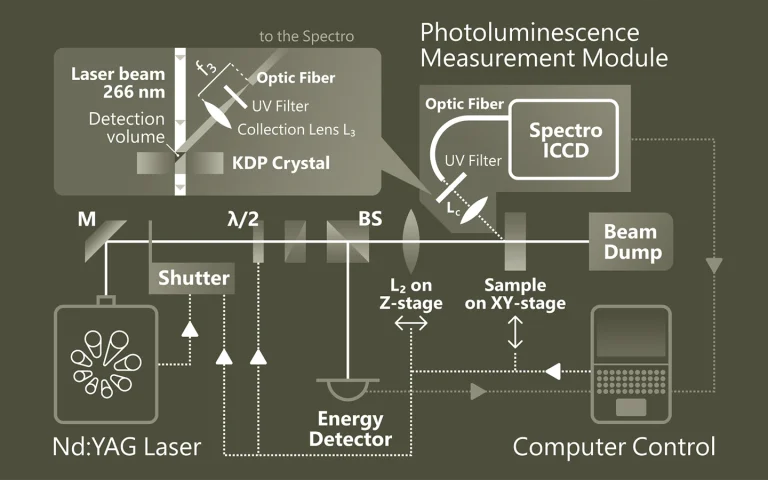
Principle of laser-induced plasma spectroscopy.