MIR Tunable Picosecond Laser System PT277

PT277 series

Mid-Infrared Tunable Single Housing Picosecond Laser System

PT277 series tunable wavelength laser systems integrate a picosecond optical parametric oscillator and DPSS pump laser into a single compact housing. The tuning range features 703 – 1024 nm, 1403 – 2020 nm, 2250 – 4400 nm, 4800 – 18500 nm with bandwidth < 4 cm‑1 in the full tuning range. Gap-free tuning is from 4800 to 18500 nm. Synchronized second output at 1064 nm.

Download datasheet

Features

  • Tuning range 703 – 18 500 nm (14 225 – 540 cm‑1)
  • Optically synchronised second output at 1064 nm
  • Hands-free tuning: motorized for the entire tuning range
  • Linewidth <4 cm‑1 in the entire tuning range
  • Nearly diffraction limited divergence
  • Beam direction stability in the entire tuning range
  • Single housing: integrates a pump laser and OPO in a single housing
  • Internal air cleaning system
  • PC control via USB (virtual COM port), RS232, LAN using REST API commands
  • Fast wavelength scan (sweep)
  • System with two independently tunable wavelengths (available on request)

Applications

  • Infrared spectroscopy
  • SNOM (scanning near field microscopy)
  • PiFM (Photoinduced Force Microscopy)
  • Nonlinear spectroscopy:
    • SFG (Sum frequency generation spectroscopy)
    • CARS (Coherent Anti-Stokes Raman Spectroscopy)

Description

The PT277 series are turn-key, single-housing mid-infrared lasers integrating a pump laser and OPO. PT277 delivers narrowband (2 – 4 cm‑1) pulses in the wide spectral range of 703 – 18 500 nm, with an optional optically synchronised second output at 1064 nm. Hands-free spectral scanning is superior for vibrational spectroscopy, nanoscopy, nonlinear spectroscopy. The Fast Scan accelerates spectral measurements through rapid wavelength switching and full-range scanning.

The laser has an internal air cleaning system to clean from water vapor and organics.

Nearly diffraction-limited divergence and beam-direction stability throughout the entire spectral tuning range are essential in tunable radiation applications requiring high-precision laser beam focusing.

Fast and fully automatic wavelength tuning is achieved by advanced microprocessor control. The wavelength tuning elements are mounted on precise closed‑loop micro-stepping motors. The temperatures of the nonlinear crystals are controlled by thermo‑controllers. No additional manual adjustment of the laser system is needed.

For customer convenience, the laser can be operated from a master device or a personal computer using various interfaces. Depending on the system configuration, control is available via the USB interface (REST API over RNDIS or VCP with ASCII commands), the RS-232 interface (ASCII commands), the LAN interface (REST API), or from the remote control pad with a backlit display that remains easy to read even while wearing laser safety glasses.

Communication interfaceDescription
USB *REST API over RNDIS
RS232ASCII commands
LANREST API
Remote control padWith a backlit display

* Default. Optional – ASCII commands over virtual serial port.

Available models

ModelFeatures
PT277-SITuning range:
1403 – 2020 nm (7127 – 4951 cm⁻¹)
2250 – 4400 nm (4444 – 2273 cm⁻¹)
PT277-XIRTuning range:
1403 – 2020 nm (7127 – 4951 cm⁻¹)
2250 – 4400 nm (4444 – 2273 cm⁻¹)
4800 – 18500 nm (2083 – 540 cm⁻¹)
-SH optionTuning range
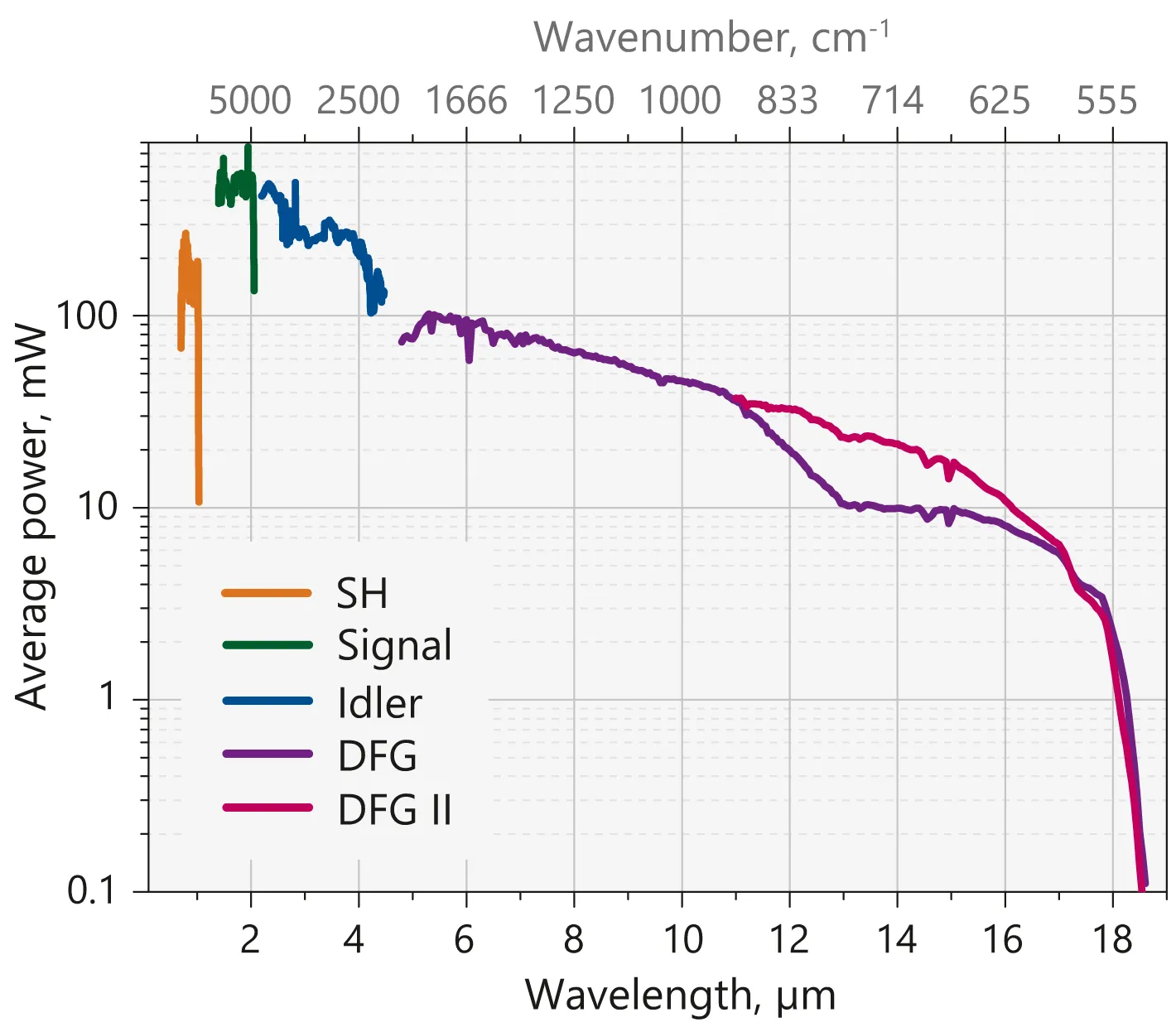
703 – 1024 nm (14 225 – 9 766 cm⁻¹)
-H optionSynchronised second output at 1064 nm

Acousto-optic modulator AOM

An acousto-optic modulator AOM is used for the output pulse train modulation. Modulation frequency range is 0 – 2 MHz.

AOM control example
ModelPT277-SIPT277-XIR
Output specifications 1)
Tuning range
Signal1403 – 2020 nm (7127 – 4951 cm‑1)1403 – 2020 nm (7127 – 4951 cm‑1)
Idler2250 – 4400 nm (4444 – 2273 cm‑1)2250 – 4400 nm (4444 – 2273 cm‑1)
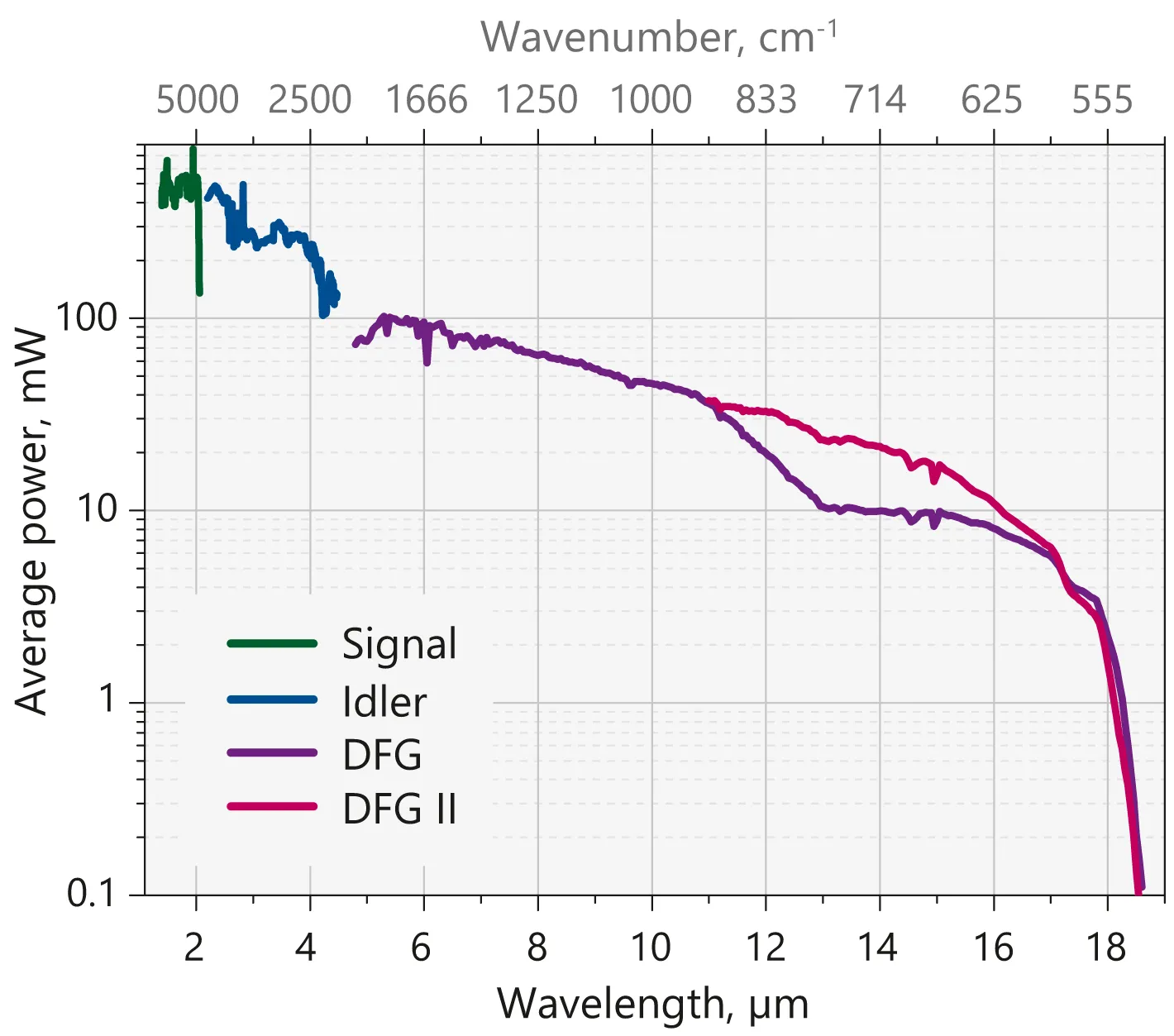
DFG–4800 – 18500 nm (2083 – 540 cm‑1)
Output power 2)
At 1403 – 2020 nm (Signal)> 400 mW> 400 mW
At 2250 – 4000 nm (Idler)> 100 mW> 100 mW
At 12500 nm (DFG)–> 10 mW
At 18000 nm–> 1 mW
Linewidth< 4 cm‑1< 4 cm‑1
Pulse repetition rate~ 87 MHz (same as pump laser)~ 87 MHz (same as pump laser)
Pulse duration7.5±1 ps7.5±1 ps
Typical beam diameter 3) (at 1/e2 level)~ 3 mm @ 3000 nm~ 3 mm @ 3000 nm
Typical beam divergence 4)< 5 mrad @ 1600 nm< 5 mrad @ 1600 nm
Beam pointing stability< 50 µrad rms @ 1600 nm< 50 µrad rms @ 1600 nm
Polarization
Signal and idlerlinear, verticallinear, vertical
DFG–linear, vertical
Sweep speed for spectral range
From 1403 to 2020 nm (Signal)< 4 s< 4 s
From 2250 to 4400 nm (Idler)< 4 s< 4 s
From 4800 to 18 000 nm (DFG)–< 2 s
Output power modulation frequency (AOM)0 Hz – 2 MHz0 Hz – 2 MHz
Physical characteristics
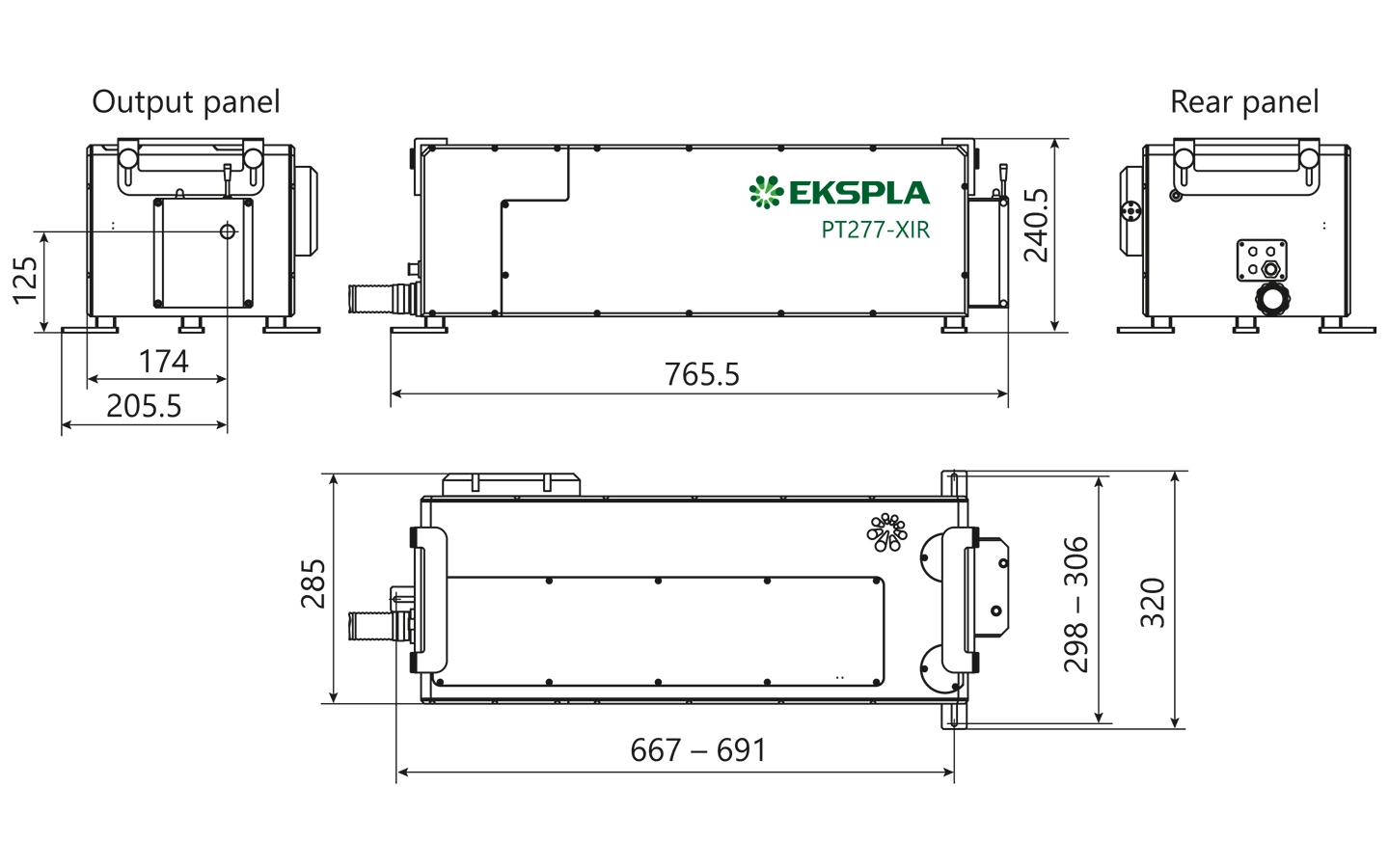
Laser unit size (W×L×H)320 × 766 × 241 mm320 × 766 × 241 mm
Power supply size (W × L × H)483 × 140 × 390 mm , stand-alone483 × 140 × 390 mm , stand-alone
Chiller (third-party, approx.) (W×L×H)290 × 420 × 290 mm , stand-alone290 × 420 × 290 mm , stand-alone
Umbilical length3 m3 m
Operating requirements
Coolingwater-airwater-air
Room temperature22 ± 2 °C22 ± 2 °C
Room temperature stability± 1 °C± 1 °C
Relative humidity< 80 % (noncondensing)< 80 % (noncondensing)
Power requirements100 – 240 VAC (-10% / +5%), single phase, 50/60 Hz100 – 240 VAC (-10% / +5%), single phase, 50/60 Hz
Power consumption< 1 kW< 1 kW
Cleanness of the roomnot worse than ISO Class 9not worse than ISO Class 9
ModelPT277-SIPT277-XIR
  1. All specifications are subject to change without notice. The parameters given in the table are indicators of the typical performance of the laser system. They may vary with each manufactured laser system.
  2. Output powers are specified at selected wavelengths. See typical tuning curves for power at other wavelengths. Power drops are possible.
  3. May vary depending on pump pulse energy.
  4. Full angle at FWHM level.

Note: The laser must be connected to the mains electricity all the time. If there will be no mains electricity for longer than 1 hour then the laser system needs to warm up for a few hours before switching radiation on. The laser and auxiliary units must be installed in a place free from dust and aerosols. It is advisable to operate the laser in an air-conditioned room and to place the laser at a distance from air conditioning outlets. The laser should be positioned on a solid optical table. Access from both sides should be ensured. Intense sources of vibrations like freight elevators, railway stations, etc. should be avoided nearby.

Option -H

Synchronised second output at 1064 nm. Output power >0.5 W.
Available with PT277-SI or PT277-XIR.

Option -SH

Tuning range 703 – 1024 nm (14 225 – 9766 cm⁻¹).
Available with PT277-SI or PT277-XIR.