Solid-phase photoluminescence spectroscopy
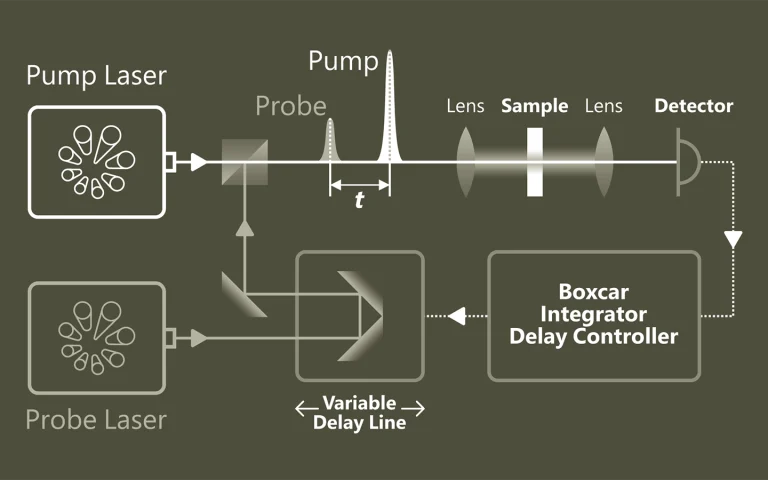
Time-resolved photoluminescence spectroscopy (TRPL) characterizes recombination and carrier transport in solid materials without contacting the sample. A pulsed laser excites luminescence and the emission is recorded as a function of time, usually with a photodiode, a streak camera or a photomultiplier tube in single-photon counting mode. Response time, spectral range and sensitivity differ widely between these configurations.
The same measurement, scanned across the sample, gives lifetime images of charge-carrier dynamics. Nonradiative recombination at the surfaces of a semiconductor device limits the efficiency of light-emitting and laser diodes, photovoltaic cells and photodetectors, so the effective carrier lifetime is a decisive parameter for solar cell conversion efficiency.
Photoluminescence microscopy resolves crystal defects in semiconductors and organometallic complexes. It is used in the manufacture of nanostructures, optoelectronic devices and solar cells.
The excitation wavelength decides which states are probed, so a TRPL setup needs a pulsed source that can be tuned across the absorption band of the sample. Tunable-wavelength lasers built around an OPO reach from 192 nm in the deep UV out to 4400 nm, while picosecond Nd:YAG lasers provide 20 – 80 ps pulses when the decay is faster than a nanosecond source can resolve.

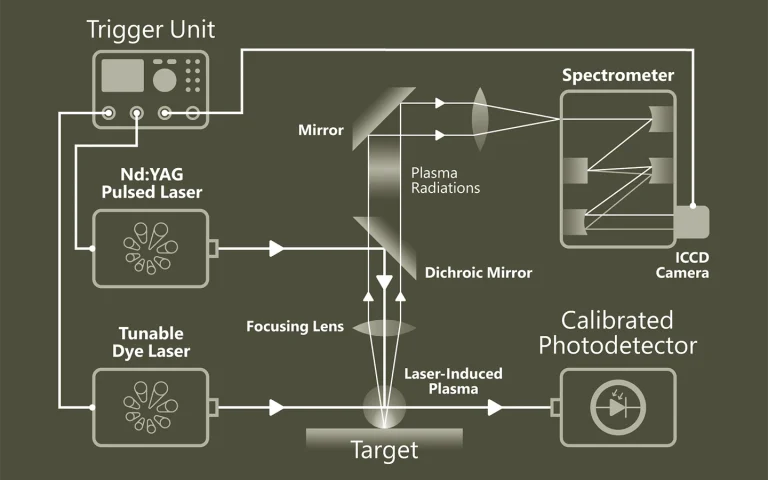
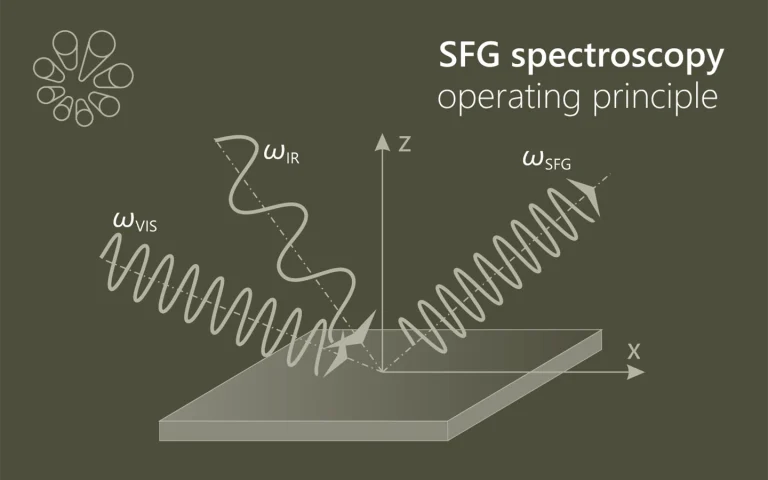
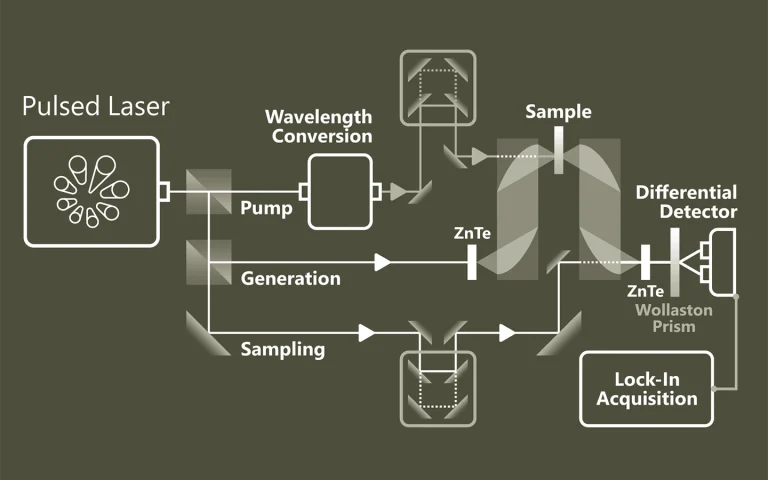
Principle of solid-phase photoluminescence spectroscopy.