
Industrial Femtosecond Lasers
Award winning industrial femtosecond lasers built to work 24/7/365 without interruption. Designed for micromachining applications it employ an innovative cooling system which enables to set new reliability standards among industrial femtosecond lasers.
Reliability redefined
Award winning industrial ultrafast lasers tailored for micromachining and other material processing applications. Unlike other industrial femtosecond lasers, FemtoLux features Direct Refrigerant Cooling system, which is military-tested (with > 90 000 hours MTBF) and ensures maintenance-free 7/24/365 operation which means substantial savings of cost and time due to the elimination of servicing and downtimes.
Ultrafast industrial laser FemtoLux offers the most flexible pulse management for the market – different GHz burst modes with the same laser source – long GHz burst mode, short GHz burst mode, MHz and GHz burst mode; PoD – pulse on demand – enabling laser to fire a pulse only when required with 20 ns (peak to peak) jitter, enabling precise control over the laser’s output and resulting in higher efficiency, accuracy and quality.
This industrial femtosecond lasers can be optimized to deliver pulse energies for practically all micromachining tasks – versions featuring high pulse energy at KHz repetition rates as well as MHz repetition rates and µJ energy levels for high speed micromachining.
By employing optional module, UV and green outputs can be achieved additionally to process different kind of materials. The whole system (laser head + power supply) features the smallest footprint in the market.
Build to meet the requirements of the most demanding materials processing applications industrial femtosecond laser FemtoLux ensures easy integration and reduces the time and efforts required to integrate this laser into any laser micromachining equipment.
Product comparison table
| Model | Available output wavelengths | Pulse duration 1) | Max output power 1) | Max repetition rate | Max pulse energy 1) |
|---|---|---|---|---|---|
| Femtosecond lasers | |||||
| FemtoLux 50 | 1030 nm 515 nm 343 nm | 400 fs – 1 ps | up to 50 W | up to 4 MHz | up to 300 μJ |
| FemtoLux HE | 1030 nm 515 nm 343 nm | 400 fs – 1 ps | ≥ 30 W | 1 MHz | 1 mJ |
| FemtoLux 30 | 1030 nm 515 nm 343 nm | 400 fs – 1 ps | ≥ 30 W | up to 4 MHz | up to 300 µJ |
| FemtoLux 3 | 1030 nm 515 nm | 300 fs – 5 ps | 3 W | 10 MHz | 3 µJ |
| Model | Available output wavelengths | Pulse duration 1) | Max output power 1) | Max repetition rate | Max pulse energy 1) |
|---|
- At fundamental wavelength.
Products range
Applications




Publications
This paper presents the precipitation of copper (Cu) from a surfactant-added glyoxylic acid copper (GACu) complex ink, in femtosecond laser multiple pulse-induced thermochemical processes to achieve high-resolution Cu direct writing. The study specifically examines the impact of the surfactant, n-decanoylsarcosine sodium, (NDSS), on the nonlinear optical absorption properties of GACu complex ink. Findings reveal that the addition of NDSS did not alter the molecule binding and single-photon absorption properties of the ink. However, nonlinear optical absorptions evaluated through the open aperture z-scan method displayed differences between the NDSS-added and non-added GACu complex inks when subjected to femtosecond laser pulse irradiation. These results suggest that Cu nanoparticles were generated from the GACu complex ink via nucleation and surfactant-mediated growth, leading to the saturable absorption of the subsequent irradiated laser pulses. By employing a pulse repetition frequency of 5 MHz and a pulse number of 2 × 10⁴, a minimum dot diameter of 1.6 ± 0.1 μm with stable reproductivity was attained with NDSS-added ink, corresponding to the laser spot diameter, without excessive precipitation due to thermal diffusion. This comprehensive understanding of the surfactant NDSS and pulse number effects on the Cu precipitation process holds potential for the direct writing of various materials. Furthermore, this insight offers a novel approach for affordable and scalable manufacturing with minimized environmental impact.
The increasing demand for miniaturized and high-performance consumer electronics has driven advancements in packaging solutions, including the transition to glass interposers. One of the critical aspects of the development is the fabrication of high-density through-glass vias (TGVs). This article presents the formation of TGVs in various glass substrates using an industrial femtosecond laser FemtoLux 30 operating in different operation modes – single-pulse, MHz burst, GHz burst and MHz+GHz burst modes. By employing burst mode and advanced machining methods such as bottom-up milling – TGVs fabrication is possible. With specific parameter sets TGVs with aspect ratios exceeding 1:80 was achieved, with drilling times as low as 350 ms. Additionally, to address current challenges in making electric traces on substrates, it introduces Selective Surface Activation Induced by Laser (SSAIL) as a unique complementary metallization technology, enabling direct copper deposition on different materials like ceramic, plastics and most importantly – glass, for complete packaging workflows. The findings demonstrate the potential of the FemtoLux femtosecond laser as a high-throughput and precise solution not only for TGV fabrication, but also for Selective Surface Activation Induced by Laser (SSAIL) based metallization – supporting next-generation semiconductor advanced packaging solutions.
As lasers expand further into industrial, research, medical, and military applications, end users are placing increased scrutiny on system cooling requirements. All lasers require a form of thermal management. The appropriate method depends on both the laser design and its operating environment: If the heat load fluctuates, for example, a user must account for both the laser’s range and rate of change.
Regardless of scale and power, overheating can lead to efficiency losses, wavelength drift, and shortened operating lifetime. Low-power lasers operating in stable environments with broad temperature tolerances can often rely on simple air cooling. On the other hand, higher-power systems, or those with tight tolerances, require more advanced methods. Today, system wall-plug efficiencies range from 0.1% to nearly 80%, and power levels can span from milliwatts in measurement and marking applications to multiple kilowatts in heavy manufacturing. Cooling design is therefore not a peripheral consideration. Instead, it is a critical factor that is central to ensuring reliability and performance across all systems and applications.
Abstract Polarization is a fundamental property of light that can be engineered and controlled efficiently with optical metasurfaces. Here, we employ chiral metasurfaces with monoclinic lattice geometry and achiral meta-atoms for resonant engineering of polarization states of light. We demonstrate, both theoretically and experimentally, that a monoclinic metasurface can convert linearly polarized light into elliptically polarized light not only in the linear regime but also in the nonlinear regime with the resonant generation of the third-harmonic field. We reveal that the ellipticity of the fundamental and higher-harmonic fields depends critically on the angle of the input linear polarization, and the effective chiral response of a monoclinic lattice plays a significant role in the polarization conversion.
Structural organization of harmonophores used in hematoxylin (H) and eosin (E) staining is studied with polarimetric multimodal second-harmonic generation (SHG), third-harmonic generation (THG) and multiphoton excitation fluorescence (MPF) microscopy in rat tail tendon histology sections. The polarimetric microscopy imaging reveals that hemalums (complexes of hematoxylin and aluminum) are well aligned with C6h symmetry along the collagen fibers in H-stained tissue, while eosin Y is partially aligned along the fibers in E-stained tissue and also follows organization of C6h symmetry. When both hemalum and eosin are used for H&E staining, the dye molecules interact and align noncentrosymmetrically with C6 symmetry along the collagen fibers, while the stained nuclei appear isotropically organized. The polar alignment of the hemalum and eosin complexes increases the achiral second order susceptibility tensor component ratio
in H&E-stained tissue. The alignment of hemalum and eosin molecules, and their complexes in collagenous tissue, must be considered in nonlinear microscopy and polarimetric analysis of H&E-stained histopathology.
Intra-volume glass scribing for cutting is one of the most advanced applications of nondiffractive laser beams. However, ever-growing requirements from the industry for complexity, miniaturization, and quality of fabricated parts have pushed the technology forward. Most of the methods developed to improve glass scribing rely on spatial and temporal pulsed beam shaping. As another degree of freedom to manipulate light, polarization has received little attention so far. In this work, we investigate the effect of linear and circular polarizations on the volumetric modification and scribing of soda-lime glass using a zero-order Bessel beam in the MHz burst regime. We demonstrate that at a certain burst energy, transverse microcracks align with the linear polarization orientation. Furthermore, we show that the polarization state affects the modified glass separation, processing speed, efficiency, and quality.
A localized energy deposition in a thin layer of liquid between two solid glass plates excites waves in the liquid, solids, and their interfaces. Of particular interest is an elastic surface wave (Rayleigh wave) on the liquid–solid interface that travels faster than the shock wave in the liquid. The surface deformation caused by the Rayleigh wave expands the layer of liquid, thereby locally reducing the pressure below the cavitation threshold. The created tension nucleates many cavitation bubbles, which later collapse due to the passage of the trailing shock wave in the liquid. Interestingly, the bubbles are not arranged homogeneously but on concentric rings centered on the location of the energy deposition. We explain the formation of the concentric rings with the interaction between neighboring bubbles. The fluid–structure interaction is modeled with a coupled finite volume solver that couples a multi-phase compressible fluid region (water and bubble gas) with an elastic solid (glass). We find that the nucleation of bubbles in such a geometry relaxes the tension in their immediate vicinity and thereby suppresses the growth of neighboring bubble nuclei. This idea is confirmed by a Rayleigh–Plesset model of a bubble driven by a far-field pressure obtained from the finite volume simulation. The observed ring patterns are thus the result of the successive activation of statistically distributed nucleation sites into explosively expanding cavitation bubbles in an axisymmetric geometry, whose strong interaction on short distances leads to a hindrance of bubble growth in radially distinct regions.
We reveal for the first time by experiments that within a narrow parameter regime, two cavitation bubbles with identical energy generated in anti-phase develop a supersonic jet. High-resolution numerical simulation shows a mechanism for jet amplification based on toroidal shock wave and bubble necking interaction. The micro-jet reaches velocities in excess of 1000 m/s. We demonstrate that potential flow approximation established for Worthington jets accurately predicts the evolution of the bubble gas-liquid interfaces.
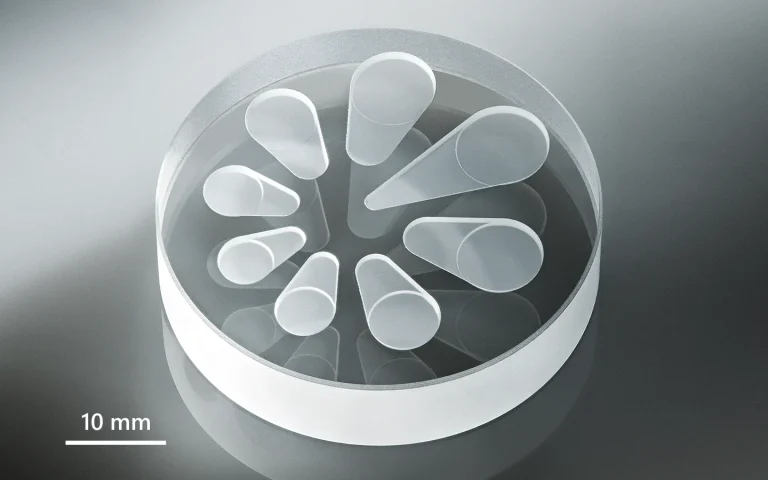
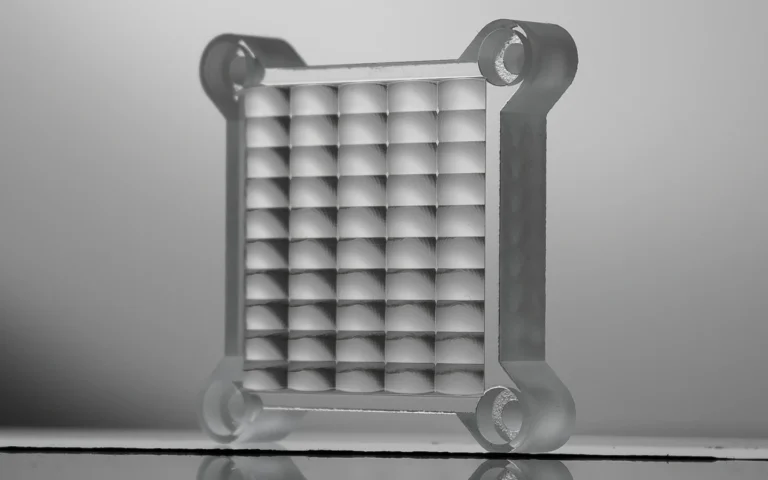
The growing demand for flexible, high-quality fabrication of free-form micro-optics drives the development of laser-based fabrication techniques for both the shape formation and surface polishing of optical elements. In this paper, we performed a thorough and systematic study on fused silica glass ablation using 10 ps and 320 fs duration pulses. Ablation processes for both pulse durations were optimized based on the measurements of the removed material layer thickness and surface roughness, and by analyzing the topographies of ablated cavities to remove material layers as thin as possible with minimum surface damage. Our findings demonstrate higher process resolution and surface quality for femtosecond pulses. Ablation of pre-roughened glass reduced the minimal removable glass layer thickness well below the 1 μm mark for both pulse durations, improving the process resolution. The minimal removable glass layer thickness was 14 times smaller for the femtosecond pulses, with up to 4.5 times lower surface roughness compared to samples processed with picosecond pulses. On the other hand, results revealed faster glass removal rates with picosecond pulses. In the end, arrays of microlenses were fabricated with both pulse durations and subsequently polished with a CO2 laser. Results revealed higher performance of microlenses fabricated with femtosecond pulses, providing better focusing capabilities and lesser beam scattering. Finally, this study demonstrated the successful fabrication of free-form optical elements with femtosecond and picosecond pulses, demonstrating the versatility and the potential of laser-based techniques.
The flow around a bubble, precipitously expanding in a thin gap between flat walls, was found to have a peculiar feature: distinct fingering occurs at the bubble wall, which was observed through the ultra-high speed optical visualization. The effect is attributed to the reversal of the flow within boundary layers, which provokes the growth of instabilities at the inflection point and, when the surface tension is low enough (the local Weber number is high enough), leads to the fingering. In this paper, we show the high speed recordings of the fingering and model the evolution of the radial velocity to quantitatively confirm feasibility of the proposed instability mechanism.
