FemtoLux 3
Microjoule Class Femtosecond Industrial Lasers
FemtoLux 3 is a modern femtosecond fiber laser aimed for both R&D use and industrial integration. It features 3 W output power and allows optimization of laser parameters for the desired application like marking and volume structuring of transparent materials, photopolymerization, biological imaging, nonlinear microscopy and many others.
Features
- At 1030 nm
3 W typical output power
up to 3 μJ/pulse and 10 μJ/burst - At 515 nm
1.2 W typical output power
up to 1.2 μJ/pulse and 5 μJ/burst - < 300 fs … 5 ps tunable pulse duration
- M² < 1.2
- Versatile laser control and syncronisation capabilities
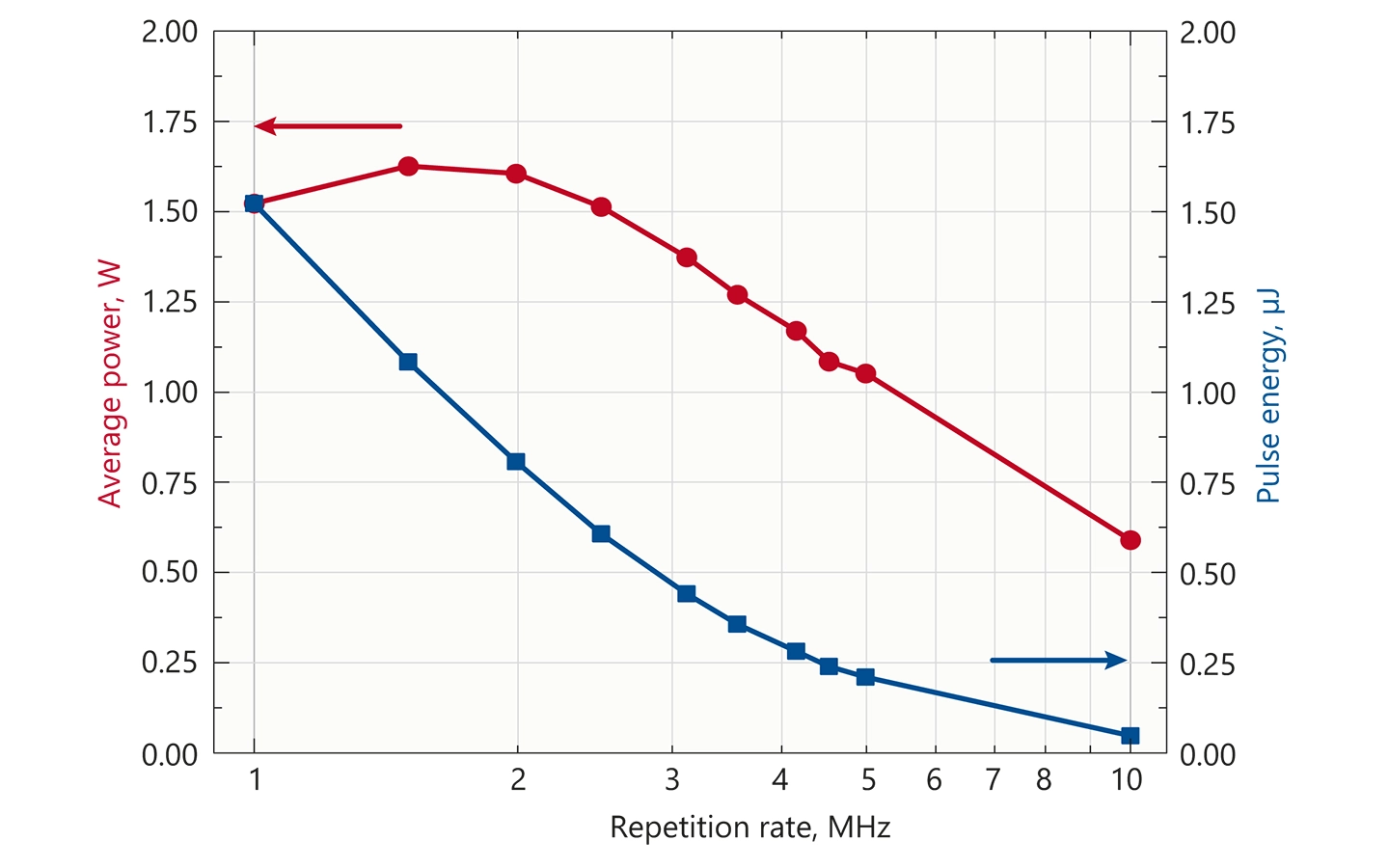
- Up to 10 MHz pulse repetition rate
- Smart triggering for synchronous operation with polygon scanner and PSO
- Instant amplitude control
- Passive air cooling of the laser head
- 24/7 operation
Applications
- Inner volume marking of transparent materials
- Marking and structuring
- Micromachining of brittle materials
- Photopolymerization
- Ophthalmologic surgery
- Biological Imaging
- Pumping of femtosecond OPO/OPA
- Microscopy
Modern femtosecond fiber laser
FemtoLux 3 is a modern femtosecond fiber laser aimed for both R&D use and industrial integration.
Tunable pulse duration in a range of 300 fs – 5 ps, adjustable pulse repetition rate up to 10 MHz and adjustable pulse energy up to 3 μJ allows optimization of laser parameters for the desired application. These include marking and volume structuring of transparent materials, photopolymerization, biological imaging, nonlinear microscopy and many others. To expand the scope of applications even further this laser can be equipped with a second harmonics module.
With burst mode enabled, FemtoLux 3 can generate bursts of pulses with energy above 10 μJ which can significantly improve the efficiency of processes.
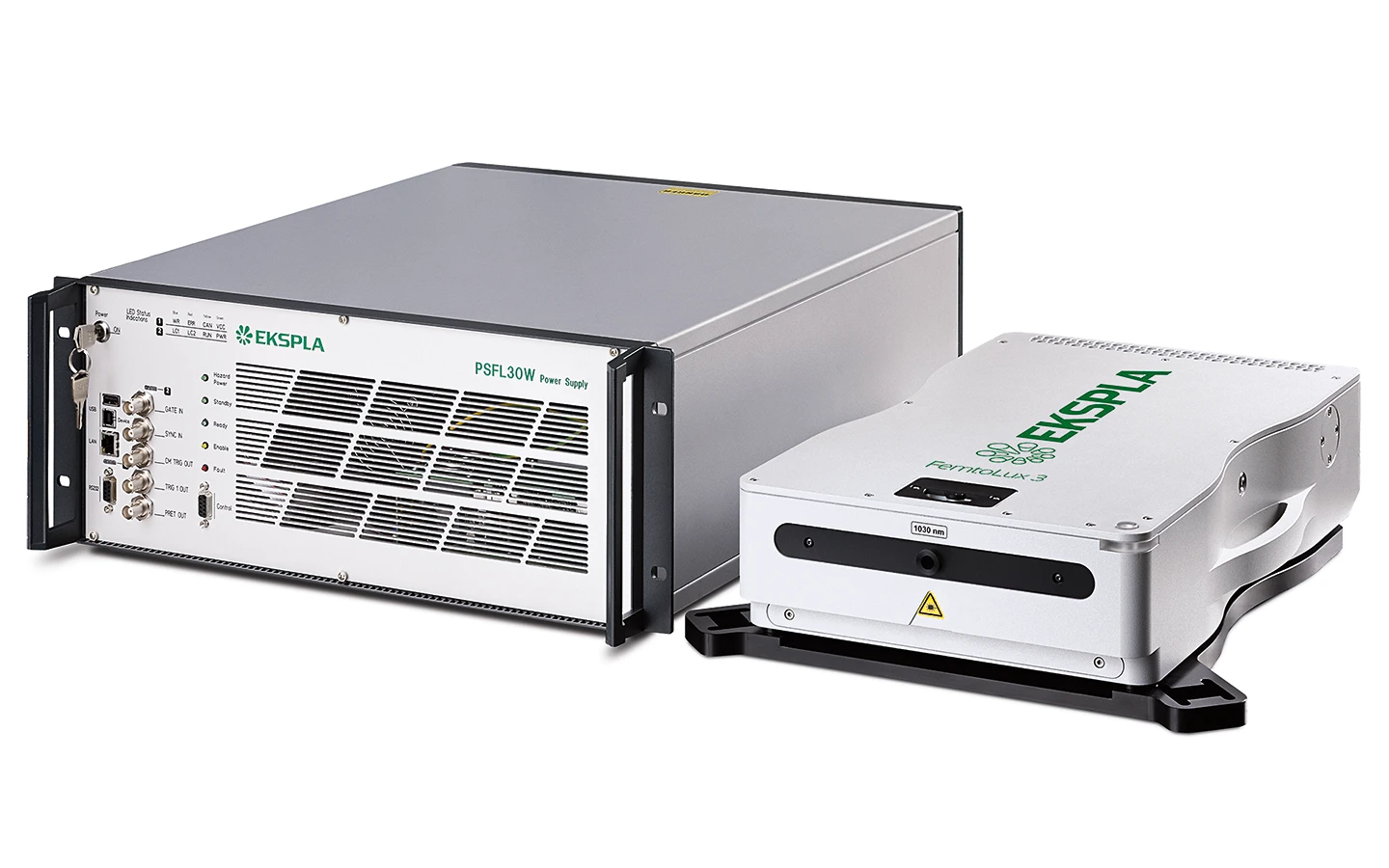
Having a rigid, compact, passive air-cooled laser head FemtoLux 3 can be integrated with different equipment, be it laser equipment for material micro-processing, microscopy or any other research equipment.
Specifications
| Model | FemtoLux 3 |
|---|---|
| Main Specifications 1) | |
| Central wavelength | |
| Fundamental | 1030 nm |
| With second harmonic option | 515 nm |
| Minimal pulse duration (FWHM) at 1030 nm | < 300 fs (typical ~230 fs) |
| Pulse duration tuning range | 300 fs – 5 ps |
| Maximal average output power 2) | |
| At 1030 nm | > 3 W |
| At 515 nm | > 1.2 W |
| Power long term stability (Std. dev.) 3) | ≤ 0.5 % |
| Maximal pulse energy 2) | |
| At 1030 nm | > 3 µJ |
| At 515 nm | > 1.2 µJ |
| Pulse energy stability (Std. dev.) 4) | < 2 % |
| Pulse repetition rate (PRR) 5) | 1 – 10 MHz |
| Pulse repetition frequency (PRF) after frequency divider | PRF = PRR / N, N=1, 2, 3, … , 65000; single shot |
| External pulse gating | via TTL input |
| Burst mode 6) | 1 – 10 pulses |
| Max burst energy | |
| At 1030 nm | > 10 µJ |
| At 515 nm | > 5 µJ |
| Burst shape control | via analog input |
| Power attenuation | 0 – 100 % from remote control application or via analog input |
| Polarization orientation | linear, vertical |
| Polarization extinction ratio | > 1000:1 |
| M2 | < 1.2 |
| Beam divergence (full angle) | < 1.0 mrad |
| Beam ellipticity (far field) | > 0.85 |
| Beam pointing stability (pk-to-pk) 7) | < 30 µrad |
| Beam diameter (1/e2) at 20 cm distance from laser aperture | |
| At 1030 nm | 2.0 ± 0.3 mm |
| At 515 nm | 1.0 ± 0.2 mm |
| Physical characteristics | |
| Cooling of the laser head | air, passive |
| Laser head size (L×W×H) | |
| At 1030 nm | 459.5 × 362 × 111 mm |
| At 515 nm | 615.3 × 362 × 139 mm |
| Power supply unit size (L×W×H) | |
| Stand-alone | 496 × 483 × 184 mm |
| 19″ rack mountable | 548 × 483 × 184 mm |
| Umbilical length | 5 m |
| Operating Requirements | |
| Mains requirements | 100 – 240 V AC, single phase 47 – 63 Hz |
| Maximal power consumption | < 500 W |
| Operating ambient temperature | 15 – 30 °C |
| Relative humidity | 10 – 80 % (non-condensing) |
| Air contamination level | ISO 9 (room air) or better |
| Classification | |
| Classification according EN60825-1 | CLASS 4 laser product |
| Model | FemtoLux 3 |
|---|
- Due to continuous improvement, all specifications are subject to change without notice. Parameters marked typical are not specifications. They are indications of typical performance and will vary with each unit we manufacture.
- See typical power and energy curves for other pulse repetition rates at Performance section.
- At 1 MHz PRR during 24 h of operation after warm-up under constant environmental conditions.
- At 1 MHz PRR under constant environmental conditions.
- When pulse picker is set to transmit every pulse.
- Pulse separation inside the burst is about 20 ns.
- Beam pointing stability is evaluated as a movement of the beam centroid in the focal plane of a focusing element.
Performance
Stability
Laser control application
Drawings
Publications
Femtosecond laser multiple pulse-induced thermochemical copper precipitation from glyoxylic acid copper complex ink with surfactant
This paper presents the precipitation of copper (Cu) from a surfactant-added glyoxylic acid copper (GACu) complex ink, in femtosecond laser multiple pulse-induced thermochemical processes to achieve high-resolution Cu direct writing. The study specifically examines the impact of the surfactant, n-decanoylsarcosine sodium, (NDSS), on the nonlinear optical absorption properties of GACu complex ink. Findings reveal that the addition of NDSS did not alter the molecule binding and single-photon absorption properties of the ink. However, nonlinear optical absorptions evaluated through the open aperture z-scan method displayed differences between the NDSS-added and non-added GACu complex inks when subjected to femtosecond laser pulse irradiation. These results suggest that Cu nanoparticles were generated from the GACu complex ink via nucleation and surfactant-mediated growth, leading to the saturable absorption of the subsequent irradiated laser pulses. By employing a pulse repetition frequency of 5 MHz and a pulse number of 2 × 10⁴, a minimum dot diameter of 1.6 ± 0.1 μm with stable reproductivity was attained with NDSS-added ink, corresponding to the laser spot diameter, without excessive precipitation due to thermal diffusion. This comprehensive understanding of the surfactant NDSS and pulse number effects on the Cu precipitation process holds potential for the direct writing of various materials. Furthermore, this insight offers a novel approach for affordable and scalable manufacturing with minimized environmental impact.
Monoclinic nonlinear metasurfaces for resonant engineering of polarization states
Abstract Polarization is a fundamental property of light that can be engineered and controlled efficiently with optical metasurfaces. Here, we employ chiral metasurfaces with monoclinic lattice geometry and achiral meta-atoms for resonant engineering of polarization states of light. We demonstrate, both theoretically and experimentally, that a monoclinic metasurface can convert linearly polarized light into elliptically polarized light not only in the linear regime but also in the nonlinear regime with the resonant generation of the third-harmonic field. We reveal that the ellipticity of the fundamental and higher-harmonic fields depends critically on the angle of the input linear polarization, and the effective chiral response of a monoclinic lattice plays a significant role in the polarization conversion.
Polar organization of H&E dyes in histology tissue revealed by polarimetric nonlinear microscopy
Structural organization of harmonophores used in hematoxylin (H) and eosin (E) staining is studied with polarimetric multimodal second-harmonic generation (SHG), third-harmonic generation (THG) and multiphoton excitation fluorescence (MPF) microscopy in rat tail tendon histology sections. The polarimetric microscopy imaging reveals that hemalums (complexes of hematoxylin and aluminum) are well aligned with C6h symmetry along the collagen fibers in H-stained tissue, while eosin Y is partially aligned along the fibers in E-stained tissue and also follows organization of C6h symmetry. When both hemalum and eosin are used for H&E staining, the dye molecules interact and align noncentrosymmetrically with C6 symmetry along the collagen fibers, while the stained nuclei appear isotropically organized. The polar alignment of the hemalum and eosin complexes increases the achiral second order susceptibility tensor component ratio

in H&E-stained tissue. The alignment of hemalum and eosin molecules, and their complexes in collagenous tissue, must be considered in nonlinear microscopy and polarimetric analysis of H&E-stained histopathology.
Rayleigh wave induced cavitation bubble structures
A localized energy deposition in a thin layer of liquid between two solid glass plates excites waves in the liquid, solids, and their interfaces. Of particular interest is an elastic surface wave (Rayleigh wave) on the liquid–solid interface that travels faster than the shock wave in the liquid. The surface deformation caused by the Rayleigh wave expands the layer of liquid, thereby locally reducing the pressure below the cavitation threshold. The created tension nucleates many cavitation bubbles, which later collapse due to the passage of the trailing shock wave in the liquid. Interestingly, the bubbles are not arranged homogeneously but on concentric rings centered on the location of the energy deposition. We explain the formation of the concentric rings with the interaction between neighboring bubbles. The fluid–structure interaction is modeled with a coupled finite volume solver that couples a multi-phase compressible fluid region (water and bubble gas) with an elastic solid (glass). We find that the nucleation of bubbles in such a geometry relaxes the tension in their immediate vicinity and thereby suppresses the growth of neighboring bubble nuclei. This idea is confirmed by a Rayleigh–Plesset model of a bubble driven by a far-field pressure obtained from the finite volume simulation. The observed ring patterns are thus the result of the successive activation of statistically distributed nucleation sites into explosively expanding cavitation bubbles in an axisymmetric geometry, whose strong interaction on short distances leads to a hindrance of bubble growth in radially distinct regions.
Amplification of Supersonic Microjets by Resonant Inertial Cavitation-Bubble Pair
We reveal for the first time by experiments that within a narrow parameter regime, two cavitation bubbles with identical energy generated in anti-phase develop a supersonic jet. High-resolution numerical simulation shows a mechanism for jet amplification based on toroidal shock wave and bubble necking interaction. The micro-jet reaches velocities in excess of 1000 m/s. We demonstrate that potential flow approximation established for Worthington jets accurately predicts the evolution of the bubble gas-liquid interfaces.
Fingering of a cavitation bubble in a thin gap: Ejection of the reversed boundary layer into the bulk flow
The flow around a bubble, precipitously expanding in a thin gap between flat walls, was found to have a peculiar feature: distinct fingering occurs at the bubble wall, which was observed through the ultra-high speed optical visualization. The effect is attributed to the reversal of the flow within boundary layers, which provokes the growth of instabilities at the inflection point and, when the surface tension is low enough (the local Weber number is high enough), leads to the fingering. In this paper, we show the high speed recordings of the fingering and model the evolution of the radial velocity to quantitatively confirm feasibility of the proposed instability mechanism.
High-speed ultrasound imaging of bubbly flows and shear waves in soft matter
In this methods paper, we explore the capabilities of high-speed ultrasound imaging (USI) to study fast varying and complex multi-phase structures in liquids and soft materials. Specifically, we assess the advantages and the limitations of this imaging technique through three distinct experiments involving rapid dynamics: the fl ow induced by a liquid jet, the dissolution of sub-micron bubbles in water, and the propagation of shear waves in a soft elastic material. The phenomena were simultaneously characterized using optical microscopy and USI with bubbles as contrast agents. In water, we use compounded high-speed USI for tracking a multi-phase flow produced by a jetting bubble diving into a liquid pool at speeds around 20 m/s. These types of jets are produced by focusing a single laser pulse below the liquid surface. Upon breakup, they create a bubbly fl ow that exhibits high reflectivity to the ultrasound signal, enabling the visualization of the subsequent complex turbulent flow. In a second experiment, we demonstrate the potential of USI for recording the stability and diffusive shrinkage of micro- and nanobubbles in water that could not be optically resolved. Puncturing an elastic material with a liquid jet creates shear waves that can be utilized for elastography measurements. We analysed the shape and speed of shear waves produced by different types of jetting bubbles in industrial gelatin. The wave characteristics were simultaneously determined by implementing particle velocimetry in optical and ultrasound measurements. For the latter, we employed a novel method to create homogeneously distributed micro- and nanobubbles in gelatin by illuminating it with a collimated laser beam.
Robust cavitation-based pumping into a capillary
Cavitation bubbles collapsing near boundaries create liquid flow through their center of mass movement, the formation of liquid jets, and long living vorticities. Here, we demonstrate robust pumping of the liquid with a compact and simple geometry, the open end of a thin-walled circular capillary tube filled with liquid. We study the dynamics of the cavitation bubbles and report on the resultant microjet formation through experiments and simulations. In the experiments, the dynamics of laser-induced cavitation bubbles are captured with high-speed microscopy. Simulations show excellent agreement with the experiments. The jet flow pumps liquid flow toward the capillary opening. The simulation reveals that, in the current study range, both the non-dimensional inner diameter of the capillary and the non-dimensional stand-off distance show influences on the jet width, and only the non-dimensional stand-off distance affects the maximum jet velocities. The results demonstrate that the confinement of the bubble within the capillary alters the anisotropic pressure field around the bubble, leading to a more mild collapse.
Acoustic resonance effects and cavitation in SAW aerosol generation
The interaction of surface acoustic waves (SAWs) with liquids enables the production of aerosols with adjustable droplet sizes in the micrometer range expelled from a very compact source. Understanding the nonlinear acousto-hydrodynamics of SAWs with a regulated micro-scale liquid film is essential for acousto-microfluidics platforms, particularly aerosol generators. In this study, we demonstrate the presence of micro-cavitation in an MHz-frequency SAW aerosol generation platform, which is touted as a leap in aerosol technology with versatile application fields including biomolecule inhalation therapy, micro-chromatography and spectroscopy, olfactory displays, and material deposition. Using analysis methods with high temporal and spatial resolution, we demonstrate that SAWs stabilize spatially arranged liquid micro-domes atop the generator’s surface. Our experiments show that these liquid domes become acoustic resonators with highly fluctuating pressure amplitudes that can even nucleate cavitation bubbles, as supported by analytical modeling. The observed fragmentation of liquid domes indicates the participation of three droplet generation mechanisms, including cavitation and capillary-wave instabilities. During aerosol generation, the cavitation bubbles contribute to the ejection of droplets from the liquid domes and also explain observed microstructural damage patterns on the chip surface eventually caused by cavitation-based erosion.
Bulk material influence on the aggressiveness of cavitation – Questioning the microjet impact influence and suggesting a possible way to erosion mitigation
In a study conducted over 10 years ago (Petkovsek and Dular, 2013) [1] we noticed that the thin metal sheet sustains less cavitation damage when it is attached to an acrylic glass (PMMA) than in the case when we attached it to quartz glass (SiO2). The reason for this was not explored at the time.
In the present paper we present a systematic study of single cavitation bubble erosion of a thin aluminum foil, which was attached to either PMMA or SiO2 plate. We show that the damage sustained on the foil attached to PMMA plate is significantly smaller regardless of the bubble collapse distance from the boundary. The result is surprising since one would expect the weak foil to be severely damaged regardless of the material it is attached to.
By femtosecond illumination and high-speed image acquisition we were able to capture the formation and progression of the shock waves, which are emitted at cavitation bubble collapse and observed that they are reflected on SiO2 boundary but that they traverse the PMMA bulk material. We offer an explanation that to achieve less damage the bulk material needs to have acoustic impedance similar to the one of the liquid medium in which cavitation occurs.
Further on, we constructed a simple composite material where PMMA was attached to the SiO2 and showed that we can partially mitigate the damage. This was further confirmed by ultrasonic cavitation erosion tests.
The results also imply that the cavitation damage originates solely from the shock wave, which is emitted at cavitation bubble collapse – consequently putting the idea of microjet impact mechanism under question. Finally, the study offers a new exciting approach to mitigate cavitation erosion by fine tuning the acoustic impedance of the coatings.