Femtosecond processing of GaAs in air and water
Gallium arsenide (GaAs) is brittle and easily damaged by accumulated heat, so it is machined with femtosecond pulses. The result also depends on what surrounds the sample: the same pulses cut differently in ambient air and under a layer of water.
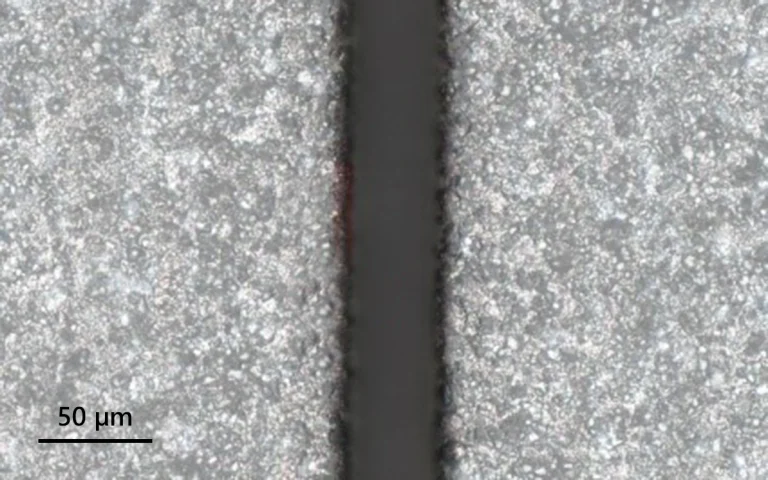
Trenches were milled in GaAs with a FemtoLux laser at 1030 nm and 900 fs, at repetition rates of 10, 50 and 200 kHz. Under a layer of water the trench depth nearly doubled, from 58 µm in ambient air to 105 µm, and the band of redeposited debris narrowed from 34 µm to 7.6 µm. Ablation efficiency was higher in water in all three regimes, about 9 µm³/µJ against 6 µm³/µJ at 10 kHz, and the gap narrowed as the repetition rate rose.

SEM image of a trench milled in GaAs under a layer of water.
Courtesy of FTMC.
Trench milling parameters in water
| Regime No. | Average laser power | Pulse repetition rate | Scanning speed | Number of scans | Fluence | Hatch | Number of lines in scan | Trench depth |
|---|---|---|---|---|---|---|---|---|
| 1 | 0.4 W | 10 kHz | 50 mm/s | 14 | 13.1 J/cm2 | 10 µm | 11 | 105 µm |
| 2 | 2 W | 50 kHz | 250 mm/s | 14 | 13.1 J/cm2 | 10 µm | 11 | 99 µm |
| 3 | 8 W | 200 kHz | 1000 mm/s | 14 | 13.1 J/cm2 | 10 µm | 11 | 75 µm |
| Regime No. | Average laser power | Pulse repetition rate | Scanning speed | Number of scans | Fluence | Hatch | Number of lines in scan | Trench depth |
|---|

Ablation efficiency of GaAs in ambient air and water environments.
Courtesy of FTMC.