

Next-generation uniLDD laser diode drivers by EKSPLA deliver high currents with exceptional stability
In diode pumping, current stability is everything. EKSPLA’s second-generation uniLDD drivers push 10 – 1200 A at under 0.1% ripple, with optional TEC channels to hold diodes and Peltier elements steady from one unit.
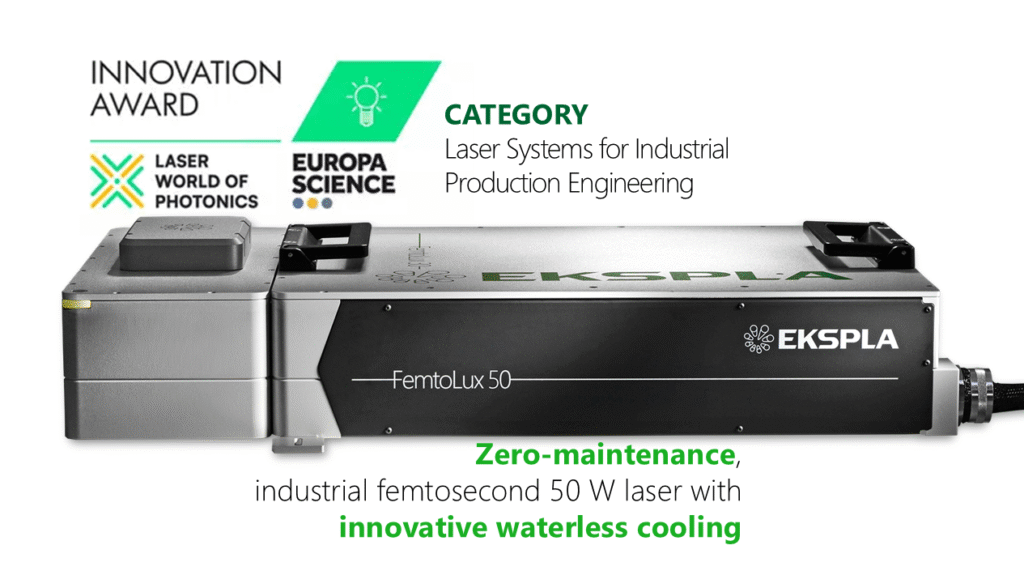
EKSPLA's industrial femtosecond laser FemtoLux 50 nominated for Innovation Award
Cooling causes roughly half of industrial laser failures, so EKSPLA’s FemtoLux 50 drops the water chiller. Its 50 W femtosecond output and waterless cooling earned a finalist spot at the Laser World of Photonics Innovation Award.

Advance in microlens fabrication with FemtoLux
Femtosecond or picosecond for cutting microlenses into fused silica? Lithuanian researchers put EKSPLA’s FemtoLux to the test, and the femtosecond pulses won on resolution and surface finish.

Ekspla boosts micromachining capabilities with FemtoLux 50
67% more power in the same footprint. EKSPLA’s FemtoLux 50 lifts femtosecond micromachining to 50 W at 1030 nm, with burst modes, pulse-on-demand control, and integrated waterless cooling in place of a chiller.

EKSPLA’s employees – among the Lithuanian Science Prize winners
The lasers behind Europe’s extreme-light labs started here. EKSPLA’s Andrejus Michailovas and Jonas Adamonis share the Lithuanian Science Prize for 15 years of work on the high-power OPCPA sources behind the SYLOS systems.

EKSPLA’s chief scientist – in the Photonics100 2025 list
Thirty years of ideas, co-authorship of 23 inventions, and decades mentoring the next generation. EKSPLA co-founder Dr. Andrejus Michailovas has been named to Electro Optics’ 2025 Photonics100 list.

We celebrate the Day of Photonics
No photonics, no selfies, no internet. On the Day of Photonics, EKSPLA traces the photon from Gilbert Lewis’s 1926 coinage to the lasers and optical fibers that wired the modern world.
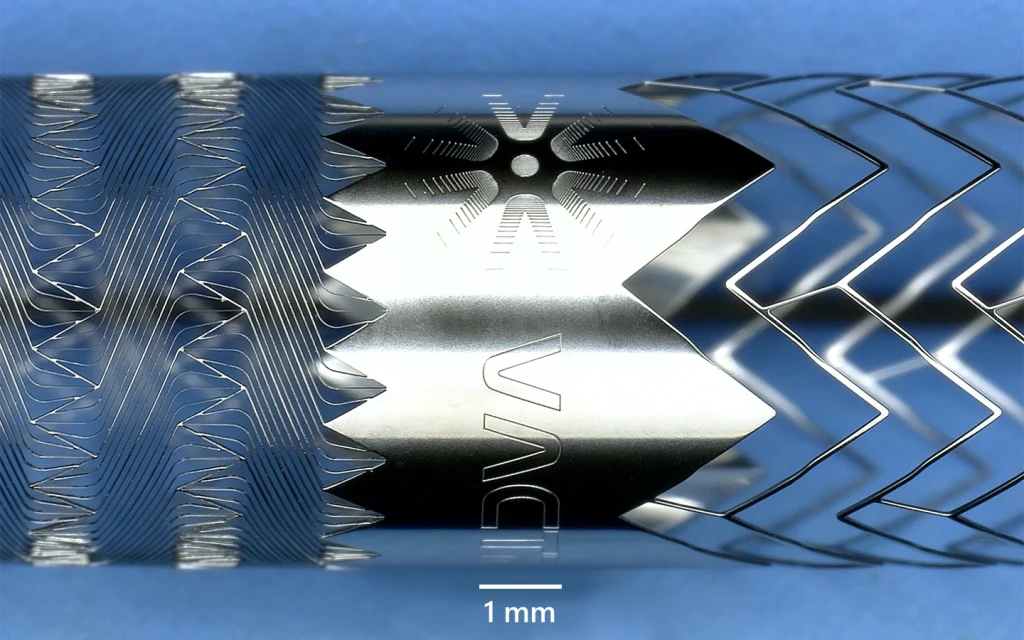
New Material Processing Applications Now Available on Ekspla Website
Glass, metal, ceramics, and polymers, all machined with one industrial laser. EKSPLA has added a fresh batch of FemtoLux material-processing samples that show what GHz and MHz+GHz burst modes make possible.
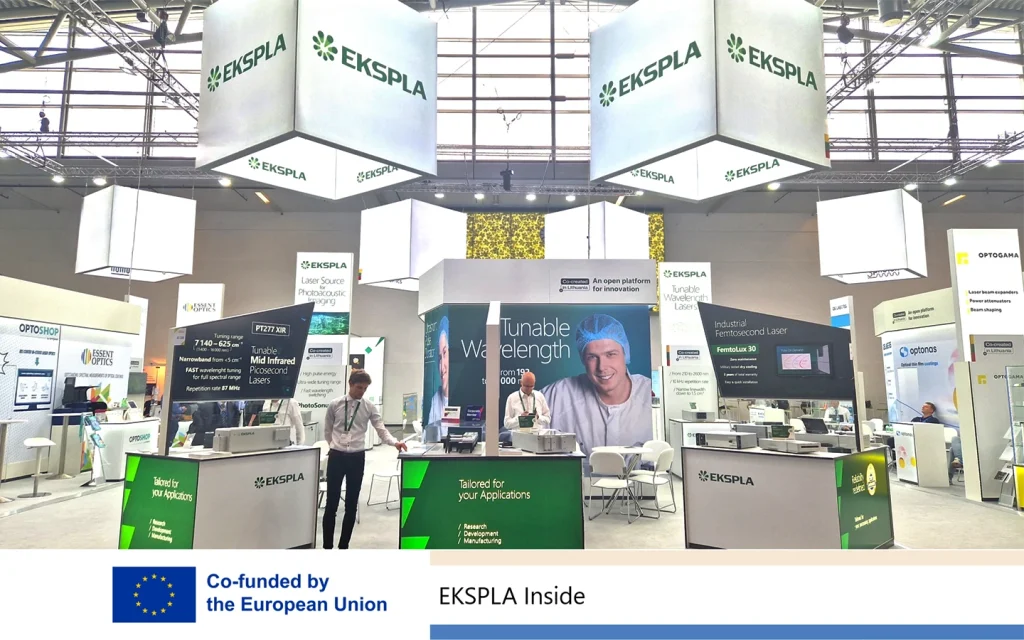
Project 'EKSPLA Inside' has launched
EKSPLA’s lasers already sit inside stent cutters, phone-glass machines, and cancer-research scanners. The EU-funded EKSPLA Inside project aims to place them inside many more OEM systems worldwide.