Femtosecond laser formation of grooves in ceramic
Ceramics are popular dielectric materials known for thermal conductivity, electrical insulation, mechanical strength, and resistance to corrosion and wear. However, conventional mechanical processing methods require large forces that lead to crack formation and can break the substrate. Femtosecond lasers process hard and brittle materials like ceramics with high quality and accuracy.
FemtoLux was tested in the initial step of ceramic scribing: groove formation. A study compared scribing speeds and quality at the 1030, 515, and 343 nm wavelengths. To estimate the influence of shorter wavelengths, 3 mm long and 50 µm deep grooves were formed on the sample surface. Scribing speeds of 44.1 mm/s were achieved at 1030 nm, and the heat-affected zone was reduced from 8.23 µm to 4.88 µm at 343 nm. The required depth was controlled by tuning the pulse energy, with demonstrated depths of 30, 50, and 70 µm.

50 µm depth groove formation in ceramic.
Courtesy of FTMC.
Profiles of formed groove

Profiles of 30, 50 and 70 µm depth grooves.
Courtesy of FTMC.
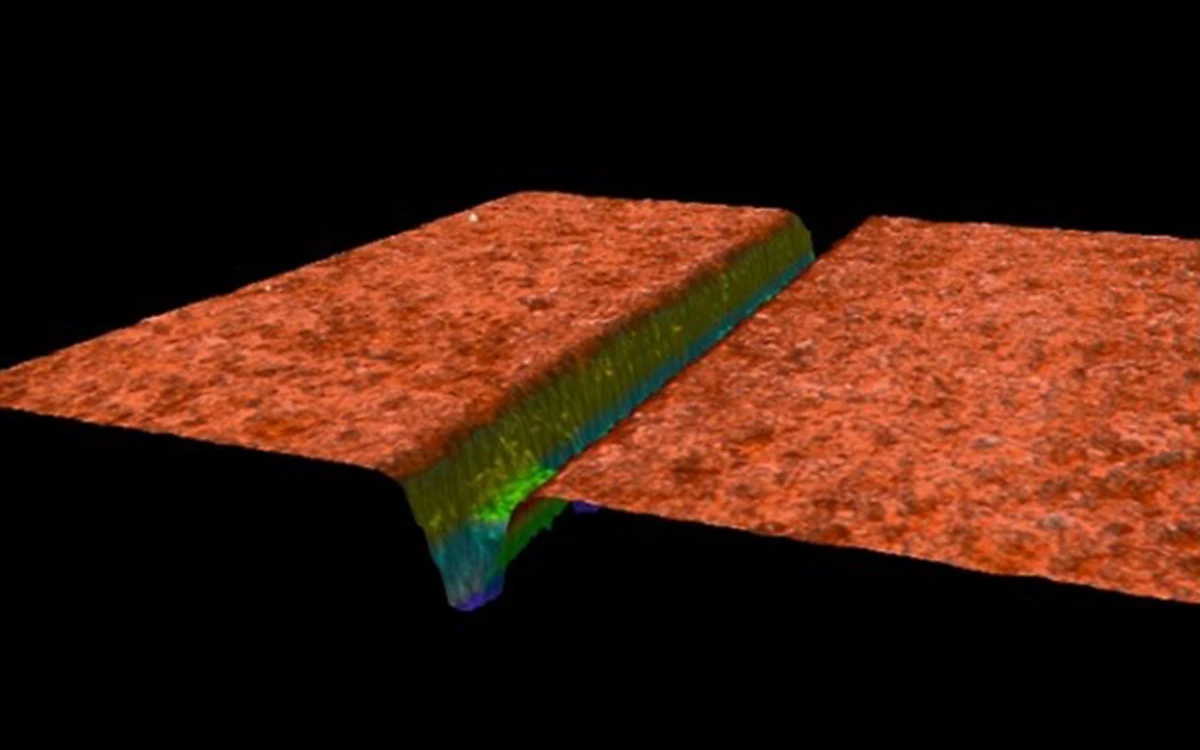
Optical 3D profilometer image of formed groove.
Courtesy of FTMC.