Ceramic processing with GHz burst
Femtosecond lasers are highly effective for processing ceramics and offer higher precision than traditional mechanical methods. However, they often fall short in throughput. The processing rate can be increased by raising the repetition rate, splitting the beam, or enlarging the spot size. Another approach is the use of GHz bursts: trains of femtosecond pulses with intra-burst repetition rates in the GHz range. A burst splits a single high-energy pulse into multiple smaller pulses, which makes fuller use of the laser power and increases the processing throughput.
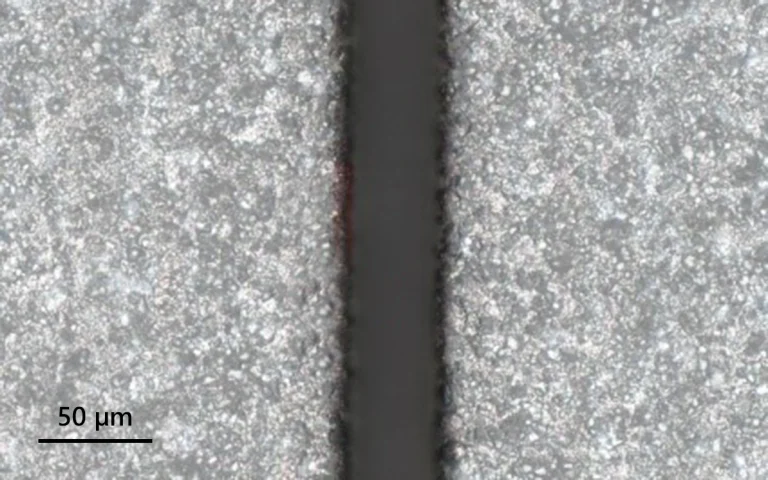
FemtoLux with its GHz burst option was used to study the influence of MHz and GHz bursts on the processing of alumina ceramics. Squares of 1×1 mm² were milled in different burst modes, and the removed volumes were measured with an optical 3D profilometer. With 92 pulses per burst in GHz mode, the process throughput increased from 6.39 mm³/min (single-pulse mode) to 10.38 mm³/min.

Optical 3D profilometer image of milled alumina squares in different operational modes.