
Photopolymerization
Photopolymerization builds a structure instead of cutting one out. Femtosecond pulses focused inside a liquid resin trigger two-photon absorption, and solidification is confined to the focal volume, where the intensity is high enough. Scanning that focus through the resin writes a solid shape point by point, in three dimensions, with almost no constraint on geometry or wall thickness.
FemtoLux 3 suits this work. It is a compact, low-power fiber laser whose 300 fs pulses are short enough to drive two-photon absorption, so solidification stays inside the focal volume. With 3 W of average power and a repetition rate up to 5 MHz (7 MHz optional), it supports the fast scanning optics that set the writing speed.
The structures shown here were written at Femtika and WOP: woodpile lattices, a nested cube frame, and open octet lattices, at scales from tens to hundreds of micrometers. The parts are used in tissue engineering, electronics, optics and microfluidics.

Photopolymerized microlattice under illumination, with an SEM detail inset.
Courtesy of Femtika.
Manufacturing examples

SEM image of a cube built from nested open frames.
Courtesy of WOP.
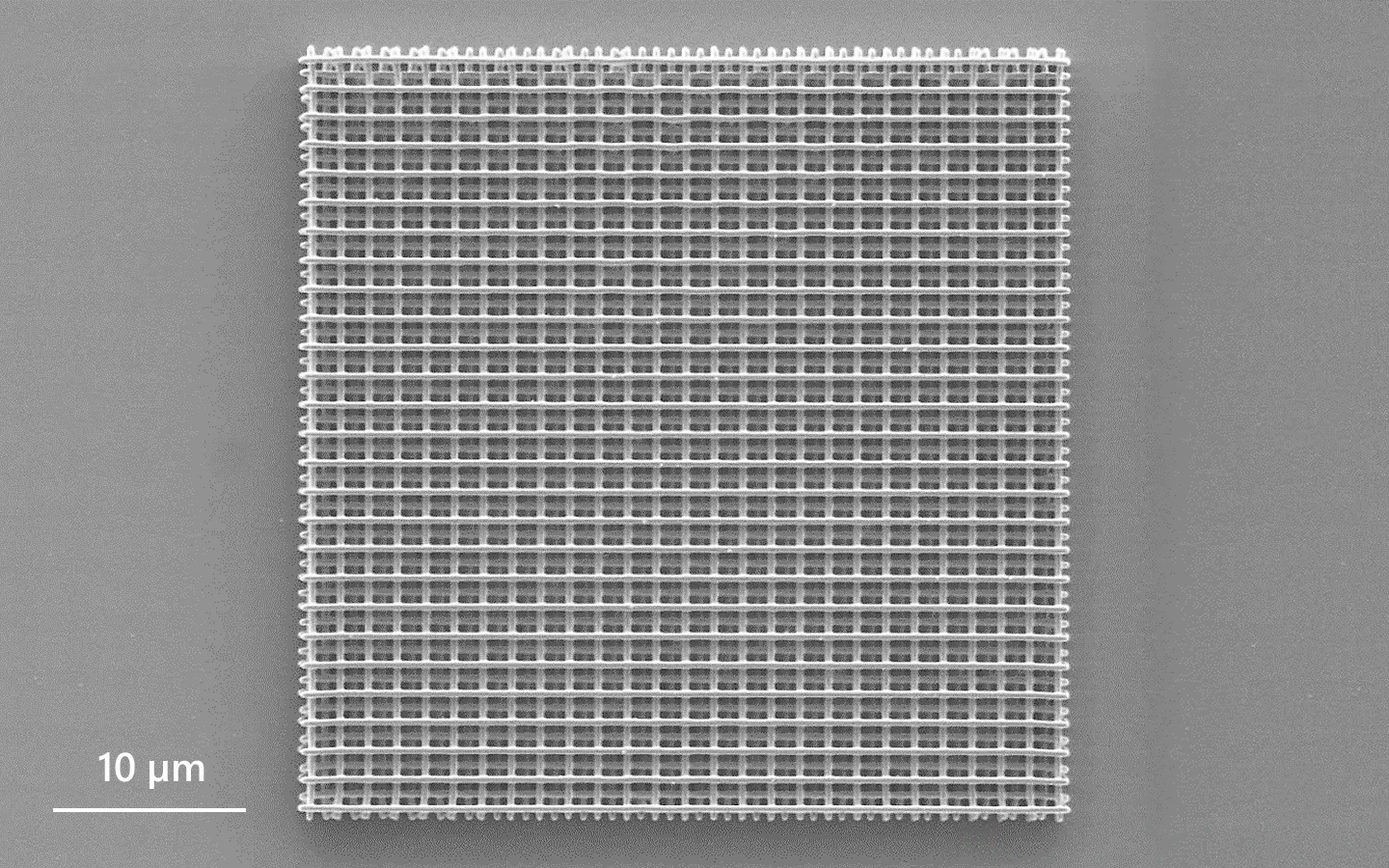
SEM image of a woodpile lattice of stacked orthogonal rods.
Courtesy of WOP.

SEM image of a cross-shaped octet lattice with diagonal bracing.
Courtesy of Femtika.
