
In the world of industrial material processing, the laser is often the most sophisticated – and sensitive – component in a workstation. Laser stability heavily depends on it’s thermal management. So for system integrators, the reliability of the entire system is directly linked to the thermal stability of the industrial laser source.
EKSPLA has released a new case study exploring a breakthrough in ultrafast laser cooling technology that moves away from traditional, high-maintenance water chillers toward a more robust “dry cooling” approach.
Drawing on best practices from U.S. military-grade engineering, EKSPLA, together with it’s partner, has developed a femtosecond laser cooling system designed to operate 24/7 for over 10 years without intervention. This “unorthodox” approach solves the most common failure points in material processing: leaks, pump failures, and other shortcomings of traditional cooling.
This transition to dry cooling offers three additional “plug-and-play” advantages for those building and installing processing workstations:
- Simplified Integration: Say goodbye to external chillers, complex plumbing, and auxiliary floor space requirements. If needed, integrators simply mount the cold plate, significantly reducing assembly time and system footprint.
- Superior Efficiency: The system consumes ~50% less energy than standard water chillers and is up to 8x more efficient than traditional Thermoelectric Cooling (TEC) systems.
- Sustainability: Utilizing low Global Warming Potential (GWP) refrigerants, this solution helps end-users meet increasingly strict environmental regulations.
By eliminating the vulnerabilities of water-based systems, integrators of material processing systems can offer their customers a more durable, compact, and energy-efficient solution.
Read full use case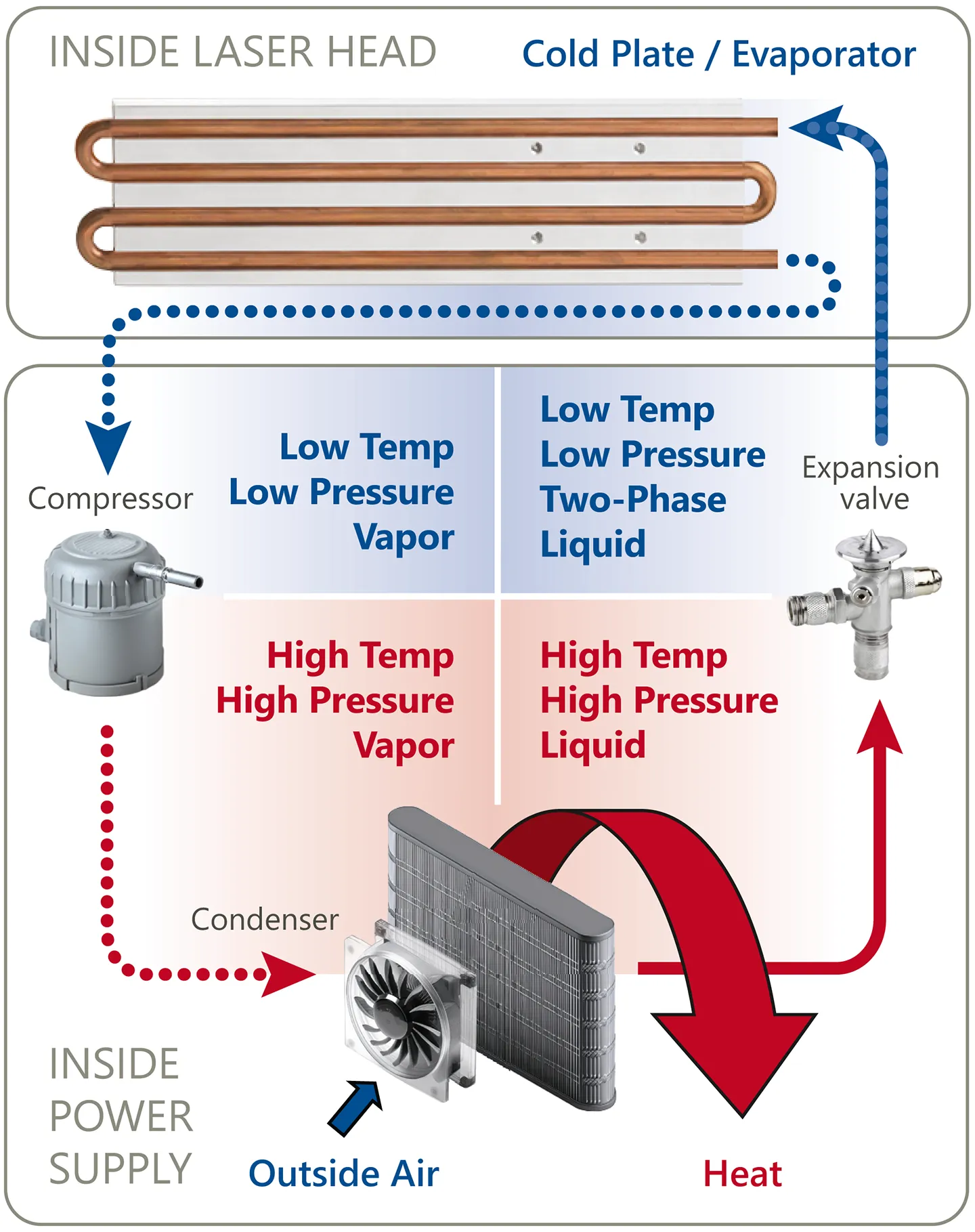
DRC layout.
Courtesy of Aspen Systems Inc.